
| La version française suit le texte anglais. YELLOWKNIFE (April 12, 2023) – The Government of the Northwest Territories (GNWT) is introducing two new scholarships in memory of Tom Williams and Alfred Moses that will recognize and celebrate students who provide positive solutions to housing programs across the Northwest Territories (NWT). These scholarships are named in the memory of former Minister Responsible for Housing NWT (previously known as the Northwest Territories Housing Corporation) Alfred Moses and former Housing NWT President and CEO Tom Williams. Mr. Moses served as Minister from April 2018 to September 2019. Mr. Williams was named President and CEO of Housing NWT in 2016 and held the position until 2021. Each demonstrated a commitment to addressing housing issues in the NWT and supporting the territory’s youth. In memory of Alfred Moses, six scholarships of $1,000 each will be awarded to high school students entering into post-secondary education. In memory of Tom Williams, six scholarships of $1,000 each will be awarded to post-secondary students. In total, there will be 12 scholarships awarded annually, two in each Housing NWT district (Beaufort-Delta, Nahendeh, North Slave, Sahtu, South Slave) including two in Yellowknife. Scholarships are available to NWT students entering a field related to housing – this could range from a trade program like carpentry or plumbing, to formal programs in project management, communications, policy or finance. Applicants will be asked to write an essay to clearly link their program with how it relates to advancing housing solutions in the NWT. Housing NWT already strongly supports the development of apprentices across the NWT in the maintenance trades and these new scholarships will provide additional support. The Alfred Moses Memorial Scholarship and Tom Williams Memorial Scholarship will support students enrolled in certificate, diploma, degree programs or other approved training programs related to housing. All NWT students are encouraged to apply. Applications will be accepted until July 5, 2023. Applicants will be notified by July 30, 2023. We encourage all NWT students to apply by downloading or requesting the application form by: · visiting https://www.nwthc.gov.nt.ca/en · emailing nwthc_comms@gov.nt.ca, or · calling (867) 767-9328. Quote(s) “These scholarships are a great way to honor two people who gave a lot to improving housing conditions across the NWT and cared a great deal for the North and its communities. We pay tribute to former Minister Alfred Moses and former President Tom Williams with these scholarships. This is also an opportunity to recognize students who demonstrate dedication, innovation, and commitment to addressing housing solutions in the NWT.” – Paulie Chinna, Minister of Housing NT Quick facts · Twelve separate scholarships of $1000 each will be awarded annually · Scholarships will be awarded in every region of the territory · Building capacity in all fields related to housing is a priority for Housing NWT · Students enrolled in certificate, diploma, degree program or other approved training program related to housing can apply Related links · https://www.nwthc.gov.nt.ca/en · www.gov.nt.ca Yellowknife, le 12 avril 2023 – Le gouvernement des Territoires du Nord-Ouest (GTNO) crée deux nouvelles bourses d’études à la mémoire de Tom Williams et d’Alfred Moses. Celles-ci auront pour but de reconnaître et de saluer les étudiants qui s’efforcent d’apporter des solutions concrètes dans le domaine du logement aux Territoires du Nord‑Ouest (TNO). Comme mentionné plus haut, ces bourses d’études ont été respectivement nommées en hommage à Alfred Moses, ministre responsable d’Habitation TNO (auparavant la Société d’habitation des Territoires du Nord-Ouest) d’avril 2018 à septembre 2019, et à Tom Williams, président et chef de la direction d’Habitation TNO de 2016 à 2021. Chacun a su s’engager pour lutter contre les problèmes de logement aux TNO et pour soutenir la jeunesse locale. Six bourses d’études Alfred-Moses, d’un montant de 1 000 $ chacune, seront attribuées à des élèves du secondaire sur le point de commencer leurs études postsecondaires. Six bourses Tom-Williams, également d’un montant de 1 000 $ chacune, seront quant à elles octroyées à des étudiants du niveau postsecondaire. Au total, 12 bourses seront remises chaque année : deux pour chaque district d’Habitation TNO (Beaufort-Delta, Nahendeh, Slave Nord, Sahtu, Slave Sud) et deux pour Yellowknife. Ces bourses sont offertes aux Ténois qui poursuivent des études dans un domaine en lien avec le logement. Il peut s’agir d’une formation à un métier spécialisé (comme la menuiserie et la plomberie) ou d’un programme d’études dans le domaine de la gestion de projets, de la communication, de la politique ou de la finance. Les candidats devront rédiger un texte dans lequel ils expliqueront clairement en quoi leur programme d’études contribue à proposer des solutions de logement aux TNO. Habitation TNO soutient déjà vivement la formation d’apprentis dans des métiers liés à l’entretien. Ces nouvelles bourses d’études viendront donc renforcer cet appui. Les bourses d’études Alfred-Moses et Tom-Williams viseront à aider les étudiants inscrits dans des programmes menant à l’obtention d’un certificat ou d’un diplôme, ou ceux qui suivent d’autres formations approuvées en lien avec le secteur du logement. Tous les étudiants des TNO sont invités à présenter une demande. Les demandes seront acceptées jusqu’au 5 juillet 2023. Les candidats recevront une réponse d’ici le 30 juillet 2023. Nous invitons tous les étudiants des TNO à présenter une demande à l’aide du formulaire adéquat. Vous pouvez le télécharger ou le demander de l’une des façons suivantes : · En visitant le site Web https://www.nwthc.gov.nt.ca/fr · En envoyant un courriel à l’adresse NWTHC_comms@gov.nt.ca · En composant le 867-767-9328 Citation « Ces bourses d’études sont un formidable moyen d’honorer deux personnes qui ont grandement contribué à l’amélioration de la situation du logement aux TNO et qui se sont beaucoup souciées du Nord et de ses collectivités. Nous rendons ainsi hommage à l’ancien ministre Alfred Moses et à l’ancien président d’Habitation TNO Tom Williams. Ces bourses sont aussi l’occasion de saluer les étudiants et les élèves qui font preuve de dévouement, d’innovation et d’engagement afin de résoudre les problèmes de logement aux TNO. » – Paulie Chinna, ministre responsable d’Habitation TNO Faits en bref · Un total de 12 bourses d’études, d’un montant de 1 000 $ chacune, seront attribuées chaque année. · Des bourses seront attribuées dans chaque région du territoire. · Le développement des capacités dans tous les domaines liés au logement est une priorité pour Habitation TNO. · Les étudiants inscrits dans des programmes menant à l’obtention d’un certificat ou d’un diplôme peuvent présenter une demande, tout comme ceux qui suivent d’autres formations approuvées en lien avec le secteur du logement. Liens connexes · https://www.nwthc.gov.nt.ca/fr · www.gov.nt.ca/fr |
Category: News
New Research Chair in Climate Change Adaptation appointed at Aurora College
La version française suit le texte anglais.
INUVIK, NT – Aurora College has appointed Dr. Garfield Giff to the position of Research Chair, Climate Change Adaptation. He will be based at the Western Arctic Research Centre (WARC) in Inuvik.
Dr. Giff holds a doctoral degree in Geodesy and Geomatics Engineering from the University of New Brunswick. He is an applied researcher with extensive experience in the socio-political, socio-economic, and technical issues associated with real world application of geomatics engineering. Dr. Giff brings more than five years of ground-breaking research and service at Aurora College to the Research Chair position and has extensive experience in Geographic Information Systems (GIS), remote sensing, northern Arctic research and education.
In his new role, Dr. Giff will work with the Western Arctic communities, Indigenous and non-Indigenous governments and researchers in translating the data collected into the development of informed climate change adaptation and resilience strategies.
Previously, Dr. Giff was Manager of the Aurora Research Institute’s (ARI) GIS Division for all ARI-based GIS projects in Inuvik. He initiated numerous research projects and partnerships and established the WARC GIS division as a premier Arctic research team. Those projects and partnerships include working with Western Arctic communities on the application of geomatics and Traditional Knowledge to map and monitor the effects of climate driven changes on their environments.
Dr. Giff’s position is one of three new Research Chair positions at Aurora College that were announced in late 2020. Each Research Chair is responsible for developing and implementing an applied research program related to Aurora College’s areas of specialization. Their work aligns with Aurora College’s strategic direction and values and will build Northern capacity and address Northern research needs.
The positions are co-funded through ArcticNet, a network of Centres of Excellence of Canada, providing $1.4 million over four years. The three positions are:
· Research Chair, Climate Change Adaptation (Western Arctic Research Centre, Inuvik)
· Research Chair, Indigenous Approaches to Environmental Management (Thebacha Campus, Fort Smith)
· Research Chair, Health and Community (Yellowknife North Slave Campus, Yellowknife)
Quotes:
“We are pleased that Dr. Giff has accepted the Research Chair position. Research Chairs aim to achieve research excellence in disciplines such as engineering and the natural sciences, health sciences, humanities and social sciences. Their work helps to improve our depth of knowledge and quality of life, and strengthen Canada’s international competitiveness. The Research Chair positions will also mentor College faculty and students, developing the next generation of researchers and applied research educators for the North. The Chairs will strengthen the relationship between research (knowledge creation), and teaching and learning (knowledge dissemination) – key to Aurora College’s transformation to a polytechnic university – and will position the College front and centre as an innovator for the NWT knowledge economy.”
– Dr. Glenda Vardy Dell, President, Aurora College
Nomination d’une nouvelle chaire de recherche sur l’adaptation au changement climatique au Collège Aurora
Inuvik, TNO – Le Collège Aurora a nommé M. Garfield Giff, docteur en géodésie et en génie géomatique, à la chaire de recherche sur l’adaptation au changement climatique. Il travaillera au Centre de recherche de l’Arctique de l’Ouest (CRAO), à Inuvik.
Doctorant de l’Université du Nouveau-Brunswick, M. Giff a consacré sa carrière à la recherche appliquée et dispose d’une vaste expérience pour utiliser l’ingénierie géomatique de façon tangible dans les domaines sociopolitiques, socio-économiques et techniques. M. Giff effectue des travaux de recherche et offre des services de premier ordre au Collège Aurora depuis cinq ans, et connaît très bien les systèmes d’information géographique (SIG), la télédétection, la recherche nordique et arctique ainsi que l’éducation.
Dans ses nouvelles fonctions, M. Giff travaillera de concert avec les collectivités, les gouvernements autochtones et non autochtones et les chercheurs de l’Arctique de l’Ouest pour interpréter les données recueillies et ainsi élaborer des stratégies d’adaptation au changement climatique.
Auparavant, M. Giff était directeur de la Division des systèmes d’information géographique et administrait les projets liés aux SIG de l’Institut de recherche Aurora (IRA), à Inuvik. Il a lancé de nombreux projets et créé de nombreux partenariats de recherche et, grâce à lui, la Division SIG de l’IRA est maintenant considérée comme une équipe de recherche de premier plan dans l’Arctique. Parmi les projets et les partenariats, notons que M. Giff a travaillé en collaboration avec les collectivités de l’Arctique de l’Ouest pour cartographier et surveiller les effets des changements climatiques sur l’environnement en utilisant la géomatique et les connaissances traditionnelles.
Le poste de M. Giff fait partie des trois nouvelles chaires de recherche mises en place au Collège Aurora qui ont été annoncées à la fin 2020. Chaque chaire aura la responsabilité de concevoir et de mettre en œuvre un programme de recherche appliquée, lié aux domaines de spécialisation du Collège Aurora. Les travaux, arrimés aux orientations et valeurs stratégiques du collège, ajouteront aux compétences ténoises et répondront aux besoins en recherche du territoire.
Ces postes seront cofinancés par l’entremise d’ArcticNet, un réseau de centres d’excellence canadiens, qui versera au Collège Aurora 1,4 million de dollars sur quatre ans. Les postes sont les suivants :
· Chaire de recherche sur l’adaptation aux changements climatiques (Centre de recherche de l’Arctique de l’Ouest, à Inuvik)
· Chaire de recherche sur les approches autochtones de la gestion environnementale (Campus Thebacha, à Fort Smith)
· Chaire de recherche sur la santé et les collectivités (Campus du Slave Nord, à Yellowknife)
Citations :
Nous sommes heureux que M. Giff ait accepté le poste de chaire de recherche. Les chaires de recherche visent l’excellence en recherche dans des disciplines telles que l’ingénierie et les sciences naturelles, humaines, sociales et de la santé. Leur travail contribue à améliorer l’étendue de nos connaissances et notre qualité de vie, ainsi qu’à renforcer la compétitivité canadienne à l’échelle internationale. Les chaires encadreront également les professeurs et les étudiants du collège, formant ainsi la prochaine génération de chercheurs et d’enseignants en recherche appliquée dans le Nord. Elles renforceront la relation entre la recherche (création de connaissances), l’enseignement et l’apprentissage (transmission des connaissances) – élément clé de la transformation du Collège Aurora en université polytechnique – et positionneront le collège en peloton de tête parmi les innovateurs en ce qui concerne l’économie du savoir aux Territoires du Nord-Ouest.
– Glenda Vardy Dell (Ph. D.), présidente du Collège Aurora
GNWT and Aurora College to transfer administration of Scientists Act
| YELLOWKNIFE (March 16, 2023) – On April 1, 2023 the Scientific Services Office and employees will be transferred to the Government of the Northwest Territories (GNWT) Department of Education, Culture and Employment (ECE) from Aurora College. This transition ensures research licensing functions under the Scientists Act will continue to reside within the GNWT after Aurora College has fully transformed into an arm’s-length polytechnic university. The Scientific Services Office licenses research in accordance with the NWT Scientists Act and promotes communication between researchers and the people of the communities in which they are conducting research. This transfer of responsibility will not affect the application process. Research licence applicants can follow the same process as in past years. The GNWT is working to ensure there are no interruptions to the licensing process due to the transfer of responsibility. This includes ensuring that ethics reviews can still occur. Only projects with human subjects require an ethics review, and many applicants will have already completed this process with their home institution. For more information on the transfer, please visit www.ece.gov.nt.ca/research-licensing. Quote(s) “Moving the administration from Aurora College to Department of Education, Culture and Employment will ensure that the administration of the Scientists Act remains within the public service as we continue to progress towards transforming the Aurora College into a polytechnic university.” – R.J. Simpson, Minister of Education, Culture and Employment “It is important for the research licensing to be moved to the regulator as is the case in other jurisdictions. This work is being completed ahead of the transformation of Aurora College to a polytechnic university.” – Dr. Glenda Vardy Dell, President, Aurora College Quick facts The Foundational Review of Aurora College recommended transferring the administration of the Scientists Act elsewhere within the GNWT as a part of the transformation process. Representatives of Aurora College and Aurora Research Institute are currently performing the duties of the Commissioner under the Scientists Act, which includes research licensing. Before Aurora College becomes a polytechnic university, these functions will be transferred to the GNWT to keep them in the public service. All research in the NWT requires a licence/permit from one of four agencies, depending on the type of research being conducted: Archaeology research – Department of Education, Culture and Employment, GNWT; Wildlife research – Department of Environment and Natural Resources, GNWT; Ocean, fish and marine mammal research – Fisheries and Oceans Canada; All other research in the NWT – Scientific Services Office, GNWT. Related links Apply for a research licence Aurora Research Institute |
| Le gouvernement des Territoires du Nord-Ouest et le Collège Aurora transfèrent l’administration de la Loi sur les scientifiques Yellowknife, le 16 mars 2023 – Le 1er avril 2023, le Bureau des services scientifiques et ses employés seront transférés du Collège Aurora au ministère de l’Éducation, de la Culture et de la Formation (MÉCF) du gouvernement des Territoires du Nord-Ouest (GTNO). Cette transition garantit que les services d’attribution de permis de recherche en vertu de la Loi sur les scientifiques continueront à relever du GTNO après la transformation complète du Collège Aurora en une université polytechnique indépendante. Le Bureau des services scientifiques délivre des permis de recherche conformément à la Loi sur les scientifiques des TNO et favorise la communication entre les chercheurs et les habitants des collectivités dans lesquelles ils mènent leurs recherches. Ce transfert de responsabilité n’affectera pas le processus de demande de permis de recherche. Les demandeurs peuvent suivre le même processus que les années précédentes. Le GTNO s’efforce d’assurer un transfert de responsabilité sans interruption, notamment en veillant à ce que les examens éthiques puissent toujours avoir lieu. Seuls les projets impliquant des sujets humains doivent faire l’objet d’un tel examen, et de nombreux demandeurs auront déjà effectué cette démarche auprès de leur établissement de référence. Pour en savoir plus sur le transfert, veuillez consulter le site www.ece.gov.nt.ca/fr/permis-recherche. Citations « Le transfert, depuis le Collège Aurora vers le ministère de l’Éducation, de la Culture et de la Formation, permettra de garantir que l’administration de la Loi sur les scientifiques reste au sein de la fonction publique, à mesure que nous continuons la transformation du Collège Aurora en université polytechnique. » – R. J. Simpson, ministre de l’Éducation, de la Culture et de la Formation « Il est important que l’attribution de permis de recherche soit confiée à l’organisme de réglementation, comme c’est le cas dans d’autres régions. Cette tâche sera achevée avant la transformation du Collège Aurora en université polytechnique. » – Glenda Vardy Dell (Ph. D.), présidente du Collège Aurora Faits en bref À la suite de l’examen des principes fondateurs du Collège Aurora, on a recommandé le transfert de l’administration de la Loi sur les scientifiques ailleurs au sein du GTNO dans le cadre du processus de transformation. Des représentants du Collège Aurora et de l’Institut de recherche Aurora exercent actuellement les fonctions de commissaire en vertu de la Loi sur les scientifiques, ce qui inclut la délivrance de permis de recherche. Avant que le Collège Aurora ne devienne une université polytechnique, ces services seront transférés au GTNO afin qu’ils restent au sein de la fonction publique. Toutes les recherches menées aux TNO nécessitent l’obtention d’une licence ou d’un permis délivré par quatre organismes, selon le type de recherche effectué: Recherche archéologique – Le ministère de l’Éducation, de la Culture et de la Formation, GTNO; Recherche sur les espèces sauvages – ministère de l’Environnement et des Ressources naturelles, GTNO; Recherche sur les océans, les poissons et les mammifères marins – Pêches et Océans Canada; Toutes les autres recherches menées aux TNO – Bureau des services scientifiques, GTNO. Liens connexes Présenter une demande de permis de recherche Institut de recherche Aurora |
NWT-built nanosatellite AuroraSat launched into space
La version française suit le texte anglais.
INUVIK, NT – At 6:30 PM Mountain Time on March 14, Aurora College’s AuroraSat nanosatellite was launched from Cape Canaveral, Florida, to the International Space Station (ISS) via a SpaceX-27 Falcon 9 rocket and Cargo Dragon spacecraft. Upon arrival at the ISS, astronauts will launch AuroraSat into an orbit around the earth.
Although it won’t pass over Inuvik, staff there will still be able to communicate with the satellite for four five-minute blocks per day. The satellite is expected to remain in orbit for approximately one year.
High school students from the Inuvik Robotics Club helped Aurora Research Institute (ARI) staff to design and build the satellite. Nine students were involved during the live of the project, including a computer science student on a six-month internship.
Since 2018, Aurora College has participated in the Canadian CubeSat Project (CCP) by constructing AuroraSat in collaboration with Yukon University and the University of Alberta. This partnership unites the three institutions and their individual CubeSats under the name Northern SPIRIT (Space Program with Interesting Research and Integrated Training). https://en.wikipedia.org/wiki/SpaceX_CRS-27
As part of the CCP, 15 student teams from post-secondary institutions in each province and territory designed and built their own CubeSats, with guidance from Canadian Space Agency experts and representatives from the Canadian space industry. A CubeSat is a miniaturized satellite that is a 10 cm x 10 cm cube, weighing less than two kilograms and typically using off-the-shelf electronic components. AuroraSat is a two-unit (2U – 10 cm x 10 cm x 22.70 cm) CubeSat.
Final preparations, including testing to ensure the CubeSats could withstand the temperatures in space, transmit data to the surface, and meet international safety protocols, were completed in late November 2022 to qualify the CubeSats to be launched into space and deployed from the ISS.
Aurora College has developed three outreach missions for AuroraSat called Northern Images, Northern Voices, and Northern Games, which aim to provide STEM outreach opportunities to youth and interested participants in the NWT at the elementary and high school levels. Alongside these outreach missions, AuroraSat will also fly a shared scientific mission, which will be conducted on the satellites built by Yukon University and the University of Alberta. Running the same experiment on all three satellites enables the gathering of spatially distributed data. More information about the shared scientific mission is available on the AlbertaSat website.
Northern Images Mission:
- The Northern Images Mission will display artwork submitted by NWT youth in front of a camera mounted on the CubeSat and photographed with the earth’s horizon in the background. NWT artists can continue to submit their artwork, as images can be uploaded and downloaded while AuroraSat orbits the Earth. For more information or to submit artwork, visit https://northernimagesmission.ca or contact cubesat@nwtresearch.com .
Northern Voices Mission:
- The Northern Voices Mission will feature recordings of northern stories about space and sky and transmit them to amateur radios across the country in various languages on a rotating schedule. The Aurora College team is currently working on the details of how to contribute recordings and the requirements needed to receive them from the satellite.
Northern Games Mission:
- The Northern Games Mission invites participants to create an interactive game for amateur radio operators around the world. Specific data packets will be transmitted in certain geographic zones, requiring global cooperation to decode the complete message. The game’s content will revolve around northern Indigenous histories and languages. The details regarding the specific frequencies and data structures that will be used in the Northern Games Mission are still under development.
Quotes:
“After many years of Northern students being involved in the design and construction of AuroraSat, through the space mission partnership (Northern SPIRIT), it is very exciting to have the payload launched from the International Space Station this month. The exposure to science, technology, engineering and mathematics (STEM) for all Northerners during the satellite build and flying virtually as part of the AuroraSat mission, will spark the next generation of Northern space explorers.”
– Joel McAlister, Vice President Research, Aurora College
“The Northern SPIRIT consortium has provided a unique opportunity to show that technical work, such as the construction of a satellite payload, can be done in the North. As we continue to transform into a polytechnic university, we hope that our participation in programs such as this provides the opportunities and awareness for the benefits of a technical post-secondary education and employment opportunities that are possible inside the NWT. “
– Patrick Gall, Engineering & Technology Projects Technician, Aurora College
AuroraSat, le nanosatellite construit aux TNO, a été lancé dans l’espace
Inuvik, TNO – À 18 h 30, heure des Rocheuses, le 14 mars, le nanosatellite du Collège Aurora, AuroraSat, a été lancé dans l’espace depuis Cap Canaveral, en Floride. Il atteindra la Station spatiale internationale (SSI) à bord de la capsule Dragon, laquelle est transportée par une fusée Falcon 9 SpaceX-27. Une fois arrivé à la station spatiale, le nanosatellite sera mis en orbite par les astronautes.
Bien que ce dernier ne passe pas au-dessus d’Inuvik, le personnel du Collège sera en mesure de communiquer avec lui quatre fois par jour, cinq minutes à chaque fois. Le nanosatellite devrait rester en orbite environ un an.
Les élèves du secondaire du club de robotique d’Inuvik ont aidé le personnel de l’Institut de recherche Aurora (IRA) à concevoir et à construire le satellite. Neuf étudiants ont contribué à la réalisation du projet, notamment un étudiant en informatique qui a travaillé sur le satellite pendant six mois dans le cadre d’un stage.
Le Collège Aurora participe à l’Initiative canadienne CubeSats depuis 2018 et travaille depuis lors à la création d’AuroraSat en collaboration avec l’Université du Yukon et l’Université de l’Alberta. Un partenariat réunit ces trois établissements postsecondaires et leurs CubeSats sous le nom de Northern SPIRIT, le Programme spatial de recherche intéressante et de formation intégrée (en anglais, le « Space Program with Interesting Research and Integrated Training »). https://en.wikipedia.org/wiki/SpaceX_CRS-27
Dans le cadre de l’Initiative canadienne CubeSats, quinze équipes, composées d’étudiants d’établissements postsecondaires de tout le pays, ont conçu et construit leur propre CubeSat, avec l’aide d’experts de l’Agence spatiale canadienne et de représentants de l’industrie spatiale canadienne. Les CubeSats sont des satellites cubiques miniatures de 10 cm x 10 cm x 10 cm et de moins de deux kilogrammes qui sont généralement construits à l’aide de composants électroniques disponibles sur le marché. AuroraSat, pour sa part, est un CubeSat composé de deux unités (2U – 10 cm x 10 cm x 22,70 cm).
Les derniers préparatifs ont été achevés fin novembre 2022. Ils comprenaient notamment des tests visant à vérifier que les CubeSats sont capables de résister aux températures de l’espace et de transmettre des données à la Terre, mais aussi qu’ils respectent les protocoles de sécurité internationaux. Leur lancement dans l’espace et leur déploiement à partir de la SSI a ainsi pu être approuvé.
Les élèves du Collège Aurora ont attribué trois missions éducatives au nanosatellite AuroraSat. Intitulées « Northern Images », « Northern Voices » et « Northern Games », elles visent à promouvoir les STIM (sciences, technologies, ingénierie et mathématiques) auprès des jeunes ténois, tant à l’école primaire qu’à l’école secondaire. En parallèle de ces missions éducatives, AuroraSat poursuit également un objectif scientifique, qui sera partagé par l’Université du Yukon et l’Université de l’Alberta : il s’agit d’exécuter la même expérience sur les trois satellites, de sorte à recueillir des données spatiales plus importantes. De plus amples renseignements sur cette mission commune sont disponibles sur le site Web d’AlbertaSat.
Mission « Northern Images » :
- La mission Northern Images vise à exposer des œuvres d’art de jeunes artistes ténois dans l’espace. Celles-ci seront prises en photo par une caméra, montée sur le CubeSat, et la Terre sera visible en arrière-plan. Les artistes des TNO peuvent continuer à soumettre leurs œuvres d’art, car les images peuvent être téléversées vers le satellite, même s’il est déjà en orbite autour de la Terre. Pour plus d’informations ou pour soumettre des œuvres d’art, visitez le northernimagesmission.ca ou contactez cubesat@nwtresearch.com.
Mission « Northern Voices » :
- La mission Northern Voices vise à transmettre des enregistrements d’histoires nordiques sur l’espace et le ciel à des radioamateurs de tout le pays, et ce, dans différentes langues et selon un horaire tournant. L’équipe du Collège Aurora travaille actuellement sur les modalités de contribution des enregistrements et sur les conditions à réunir pour que le satellite soit en mesure de les recevoir.
Mission « Northern Games » :
- La mission Northern Games permet aux participants de créer un jeu interactif pour les radioamateurs du monde entier. Ces derniers devront décoder un message à l’aide de paquets de données spécifiques transmis dans certaines zones géographiques; il leur faudra ainsi collaborer avec le reste du monde pour obtenir l’entièreté du message. Le contenu du jeu s’articulera autour de l’histoire et des langues autochtones du Nord. L’équipe travaille actuellement sur les fréquences et sur les structures de données qui seront utilisées dans le cadre de cette mission.
Citations :
« Après de nombreuses années passées sur la conception et la construction du nanosatellite AuroraSat, les étudiants ténois vont enfin pouvoir voir l’aboutissement du projet Northern SPIRIT. Nous sommes très excités à l’idée de bientôt observer le lancement en orbite du nanosatellite depuis la Station spatiale internationale. La construction de ce dernier et son temps dans l’espace nous permettent de promouvoir les sciences, la technologie, l’ingénierie et les mathématiques (STIM) auprès de tous les résidents des TNO, ce qui donnera, je l’espère, naissance à une génération d’explorateurs de l’espace ténois. »
– Joel McAlister, vice-président à la recherche du Collège Aurora
« Le consortium Northern SPIRIT a été l’occasion parfaite de prouver qu’un travail technique, tel que la construction d’une charge utile de satellite, peut être effectué dans le Nord. Alors que nous poursuivons notre transformation en université polytechnique, nous espérons que notre participation à des initiatives comme celle-ci nous permettra de faire connaître les avantages d’un enseignement postsecondaire technique et les possibilités d’emploi qui existent aux TNO. »
– Patrick Gall, technicien de projets d’ingénierie et de technologie du Collège Aurora
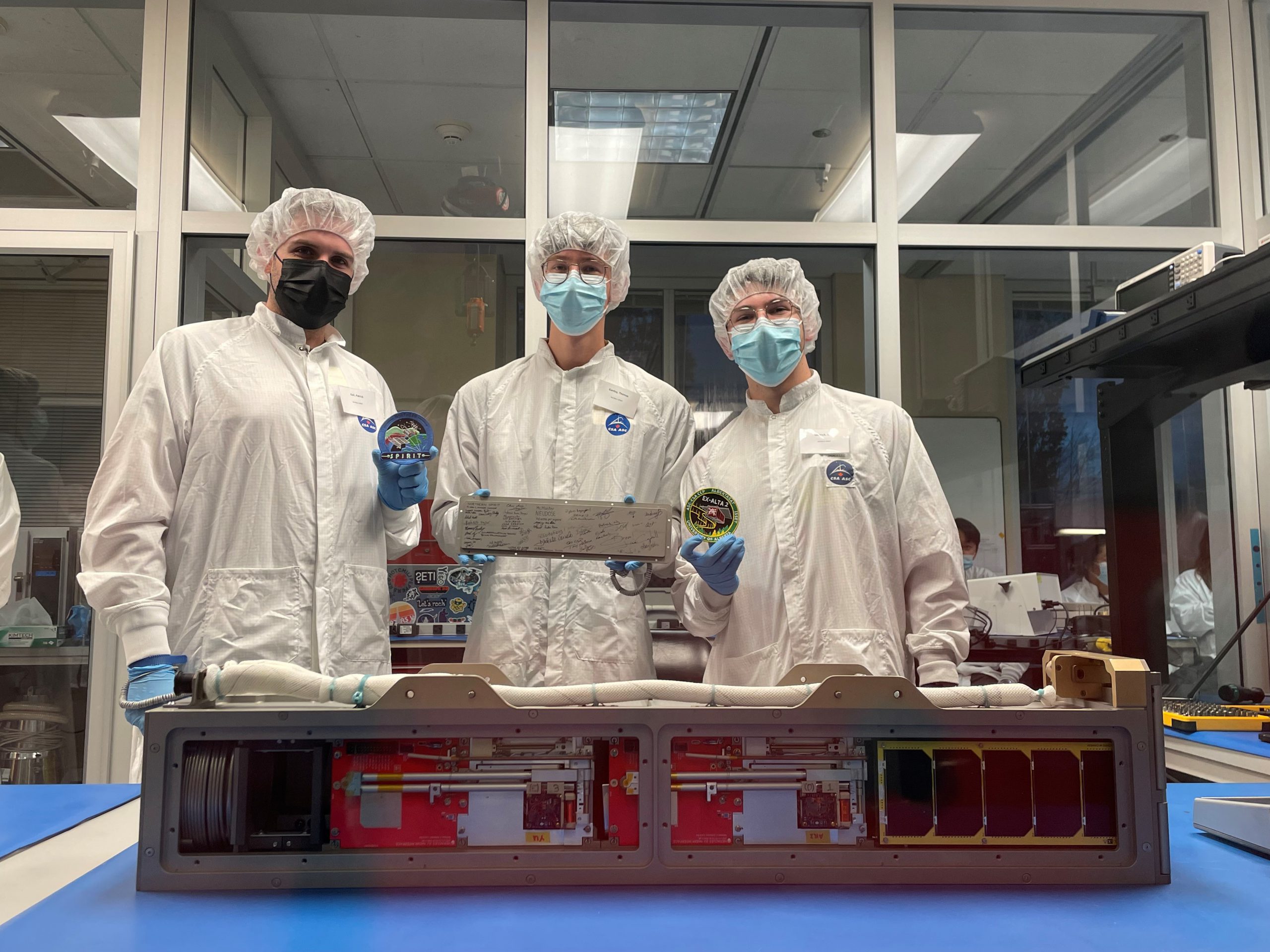
Patrick Gall, Engineering and Technology Projects Technician, Aurora Research Institute, with fellow Group D members Thomas Ganley and Josh Lazaruk with their CubeSats – AuroraSat, YukonSat and NEODOSE (McMaster University) – which have been integrated into the deployer. (Photo Courtesy of Patrick Gall)
Patrick Gall, technicien de projets d’ingénierie et de technologie à l’Institut de recherche Aurora, et ses collègues du groupe D, Thomas Ganley et Josh Lazaruk, avec leurs CubeSats : AuroraSat, YukonSat et NEODOSE (Université McMaster), lesquels ont été intégrés au dispositif de déploiement. (Photo : Patrick Gall)
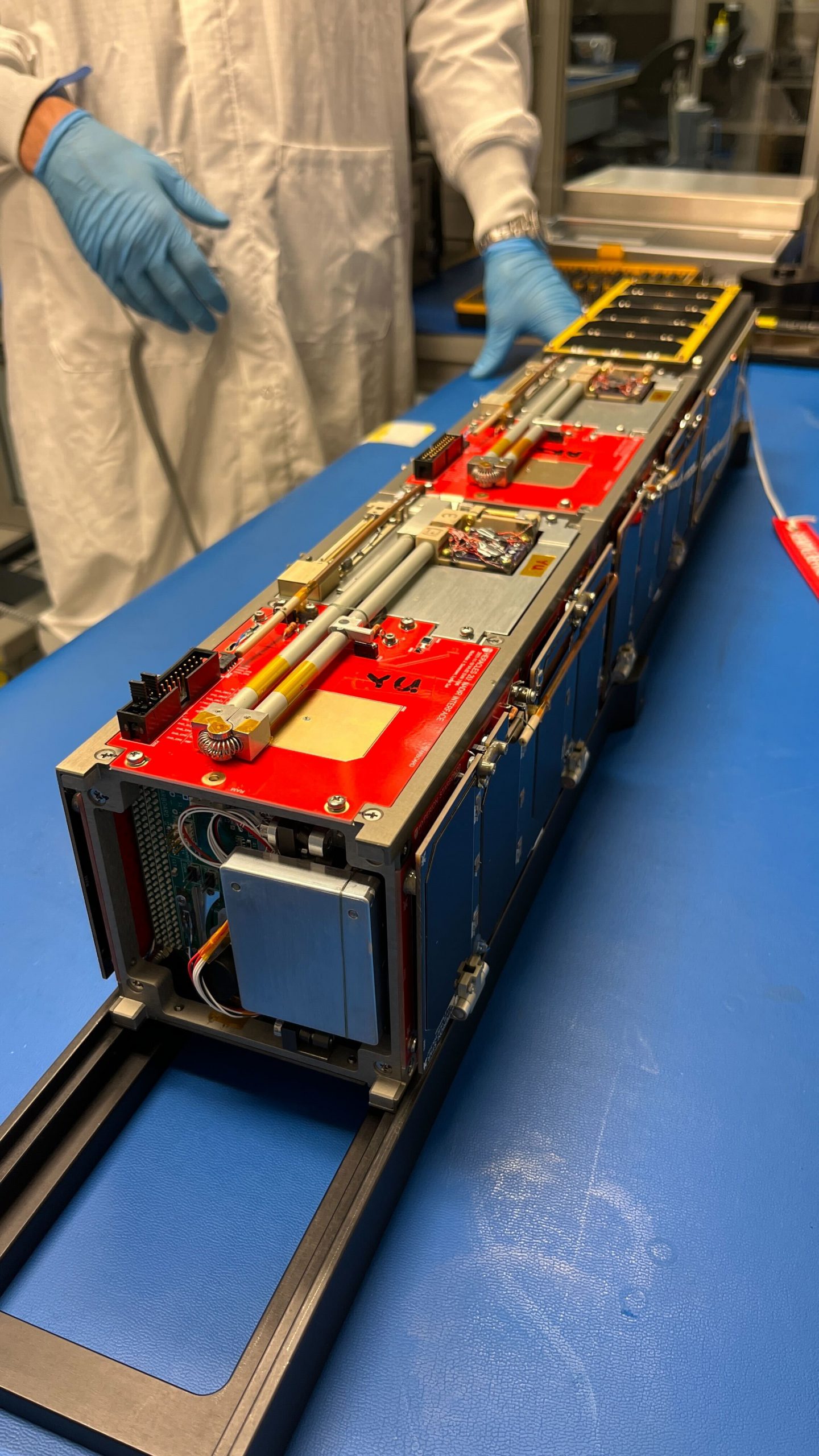
YukonSat, AuroraSat and NEODOSE sitting on the integration jig. The Northern Images mission payload sitting on the end of YukonSat, nearest the camera. (Credit Joanne Cai, University of Alberta)
YukonSat, AuroraSat et NEODOSE sur le dispositif d’intégration. La charge utile de la mission Northern Images est placée à l’extrémité de YukonSat, le plus proche possible de la caméra. (Photo : Joanne Cai, Université de l’Alberta)
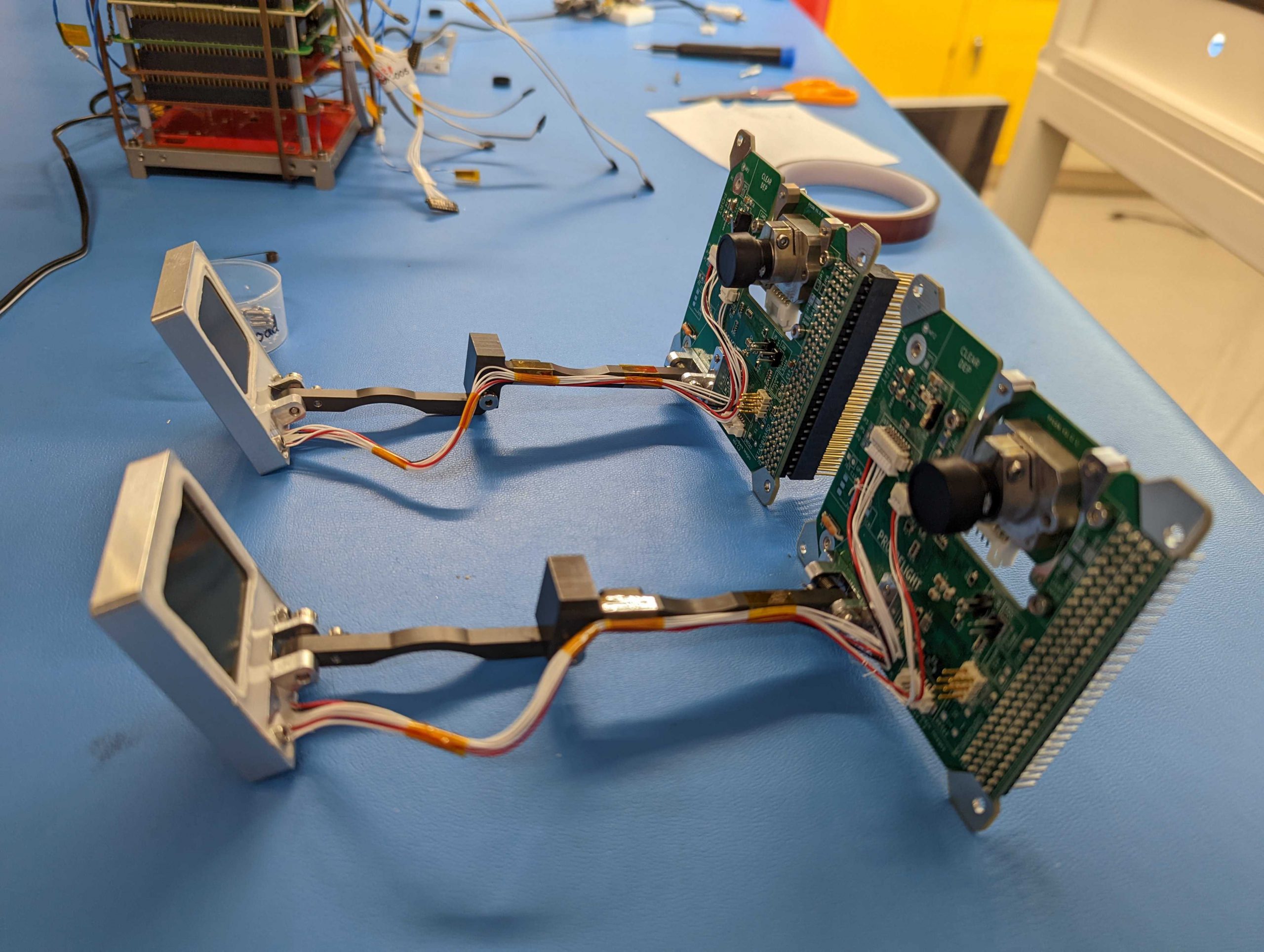
Two copies of the Northern Images Mission, designed and assembled in the NT, ready for assembly into the rest of the satellite. One copy ended up on AuroraSat, and the second on YukonSat.
Deux exemplaires des dispositifs nécessaires à la mission Northern Images, conçus et assemblés aux TNO, prêts à être assemblés au reste du satellite. Un exemplaire a été installé sur AuroraSat et le second sur YukonSat.
Aurora College Board of Governors members appointed
La version française suit le texte anglais.
After a lengthy nomination and review process, Aurora College and the Government of the Northwest Territories (GNWT) are pleased to share that the Aurora College Board of Governors nomination process has been completed and the following individuals have been appointed:
- Joseph Handley, Yellowknife
- Lorraine Tordiff, Fort Smith
- Lucy Kuptana, Tuktoyaktuk
- Rebecca Plotner, Yellowknife
- Tom Colosimo, Hay River
- Jack Rowe, Hay River
- David Hurley, Yellowknife
- Kevin Antoniak, Fort Smith
- Stephanie Irlbacher-Fox, Yellowknife
- Richard Boudreault, Montreal, PQ (McGill University)
- Cayla Gillis, Fort Smith
- Wanda Roberts, Yellowknife
- Xiaoyi Yan, Yellowknife
Together, this group will help ensure an effective and efficient governance approach that is reflective of the people of the Northwest Territories.
Aurora College in in the process of becoming arm’s-length from the Government of the Northwest Territories. As part of becoming arm’s-length, a new tricameral governance system made up of the Board of Governors (the Board), Academic Council and Indigenous Knowledge Holders Council will be established. The relationship between the Board and the GNWT will also change to reflect national standards and best practices in post-secondary education. The Board is the first of the three new governing bodies to be established.
Board members were selected based on a list of competencies established under the Aurora College Act, which include: membership on a board of directors, leadership of large organizations, financial planning, facilities management, post-secondary education, reconciliation, understanding of small and remote communities, northern economic development, northern social development, and public policy. Each member does not need to possess all of the competencies, but rather may bring one or more competencies to the Board.
Re-establishing the Aurora College Board of Governors is a critical milestone and important step in transforming Aurora College to a polytechnic university. To download a copy of the critical milestone timeline for Aurora College Transformation or read more about Aurora College, please visit: Aurora College Transformation (gov.nt.ca) and Aurora College.
Quotes:
“The establishment of the Board of Governors is the first step in the implementation of the new tricameral governance system, which will be the first of its kind in Canada. Other post-secondary institutions have tricameral governance structures but the difference is that Aurora College’s Indigenous Knowledge Holders Council will be comprised of only Indigenous people from across the NWT. The governance structure it will help Aurora College become increasingly effective, efficient, sustainable and better positioned to demonstrate leadership in the delivery of relevant and meaningful education and research rooted in strong connections to Northern land, tradition, community and people.”
- Dr. Glenda Vardy Dell, President, Aurora College
“While I have enjoyed the challenges and opportunities the role of Aurora College Administrator has offered, I am excited to see the installation of the new Board of Governors. The focus on member competencies and ensuring Northern Indigenous representation on the Board will help ensure that the interests and needs of Northerners remain a priority.”
- Denny Rodgers, Administrator, Aurora College
“Amendments to the Aurora College Act that came into force in May 2022 establish a new tricameral governance system for Aurora College. The re-establishment of the Aurora College Board of Governors is the first towards implementing the new governance model. As the Minister responsible for Post-Secondary Education in the NWT, I am pleased to see this critical milestone in the transformation of Aurora College to a polytechnic university completed and look forward to working with the Board and its Chairperson as laid out in the Aurora College Mandate Agreement. I would also like to take this opportunity to acknowledge and thank Mr. Denny Rodgers for his work as Administrator over the past six years”.
- R.J. Simpson, Minister, Minister of Education, Culture and Employment, Government of the Northwest Territories
Nomination des membres du Conseil des gouverneurs du Collège Aurora
Après un long processus de nomination et d’examen, le Collège Aurora et le gouvernement des Territoires du Nord-Ouest (GTNO) sont heureux d’annoncer que le processus de nomination du conseil des gouverneurs du Collège Aurora est terminé et que les personnes suivantes ont été nommées :
- Joseph Handley, Yellowknife
- Lorraine Tordiff, Fort Smith
- Lucy Kuptana, Tuktoyaktuk
- Rebecca Plotner, Yellowknife
- Tom Colosimo, Hay River
- Jack Rowe, Hay River
- David Hurley, Yellowknife
- Kevin Antoniak, Fort Smith
- Stephanie Irlbacher-Fox, Yellowknife
- Richard Boudreault, Montréal, Québec (Université McGill)
- Cayla Gillis, Fort Smith
- Wanda Roberts, Yellowknife
- Xiaoyi Yan, Yellowknife
Ce groupe permettra d’assurer une gouvernance efficace et efficiente qui reflète la population des Territoires du Nord-Ouest.
Le Collège Aurora est en voie de devenir indépendant du gouvernement des Territoires du Nord-Ouest. Afin de contribuer à cette indépendance, un nouveau système de gouvernance tricaméral composé du Conseil des gouverneurs (le Conseil), de la Commission des études et du Conseil des détenteurs du savoir traditionnel sera mis en place. La relation entre le Conseil et le GTNO sera également modifiée afin de refléter les normes nationales et les meilleures pratiques en matière d’éducation postsecondaire. Le Conseil est le premier des trois nouveaux organes directeurs à être mis en place.
Les membres du Conseil ont été sélectionnés en fonction d’une liste de compétences établie en vertu de la Loi sur le Collège Aurora, qui comprend : l’appartenance à un conseil d’administration, l’expérience du leadership de grandes organisations, la planification financière, la gestion des installations, l’éducation postsecondaire, la réconciliation, la compréhension des petites collectivités et des collectivités éloignées, le développement économique et social du Nord, et les politiques publiques. Chaque membre n’est pas tenu de posséder toutes les compétences, mais chacun peut apporter une ou deux compétences différentes.
Le rétablissement du Conseil des gouverneurs du Collège Aurora est une étape critique dans la transformation du Collège Aurora en une université polytechnique. Pour télécharger une copie de l’échéancier des étapes critiques de la transformation du Collège Aurora ou pour en savoir plus sur le Collège Aurora, visitez le site Transformation du Collège Aurora (gov.nt.ca) et Collège Aurora.
Citations
« La création du Conseil des gouverneurs est la première étape de la mise en œuvre du nouveau système de gouvernance tricaméral, qui sera le premier du genre au Canada. D’autres établissements postsecondaires ont des structures de gouvernance tricamérales, mais la différence réside dans le fait que le Conseil des détenteurs du savoir traditionnel du Collège Aurora ne sera composé que d’Autochtones des TNO. La structure de gouvernance aidera le Collège Aurora à devenir de plus en plus efficace, efficient et durable et à mieux se positionner pour faire preuve de leadership dans la prestation de programmes de formation et de recherche pertinents et utiles ayant des liens solides avec la terre, les traditions, les collectivités et les gens du Nord. »
- Glenda Vardy Dell (Ph. D.), présidente du Collège Aurora
« Bien que j’apprécie les défis et les possibilités que comportait le rôle d’administrateur du Collège Aurora, je suis très heureux de la création du nouveau Conseil des gouverneurs. L’accent mis sur les compétences des membres et la représentation des Autochtones du Nord au sein du Conseil permettront de s’assurer que les intérêts et les besoins des habitants du Nord restent une priorité. »
- Denny Rodgers, administrateur du Collège Aurora
« Les modifications apportées à la Loi sur le Collège Aurora, entrées en vigueur en mai 2022, établissent un nouveau système de gouvernance tricaméral pour le Collège Aurora. Le rétablissement du Conseil des gouverneurs du Collège Aurora est la première étape de la mise en œuvre du nouveau modèle de gouvernance. À titre de ministre responsable de l’éducation postsecondaire aux TNO, je suis heureux de voir la réalisation de cette étape critique de la transformation du Collège Aurora en une université polytechnique franchie et j’ai hâte de travailler avec le Conseil et son président, comme le prévoit l’entente de mandat du Collège Aurora. J’aimerais également profiter de l’occasion pour souligner le travail de M. Denny Rodgers en tant qu’administrateur au cours des six dernières années, et le remercier. »
- R.J. Simpson, ministre de l’Éducation, de la Culture et de la Formation, gouvernement des Territoires du Nord-Ouest
Northern Nursing Research Day celebrates Aurora College students
La version française suit le texte anglais.
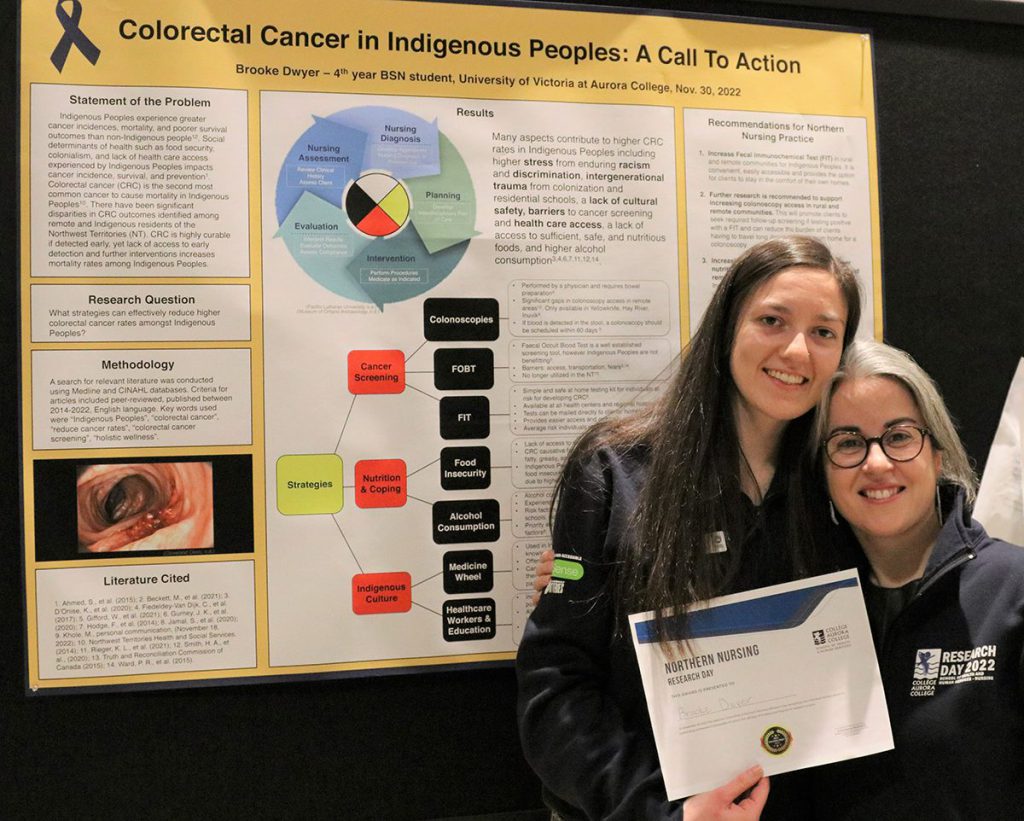
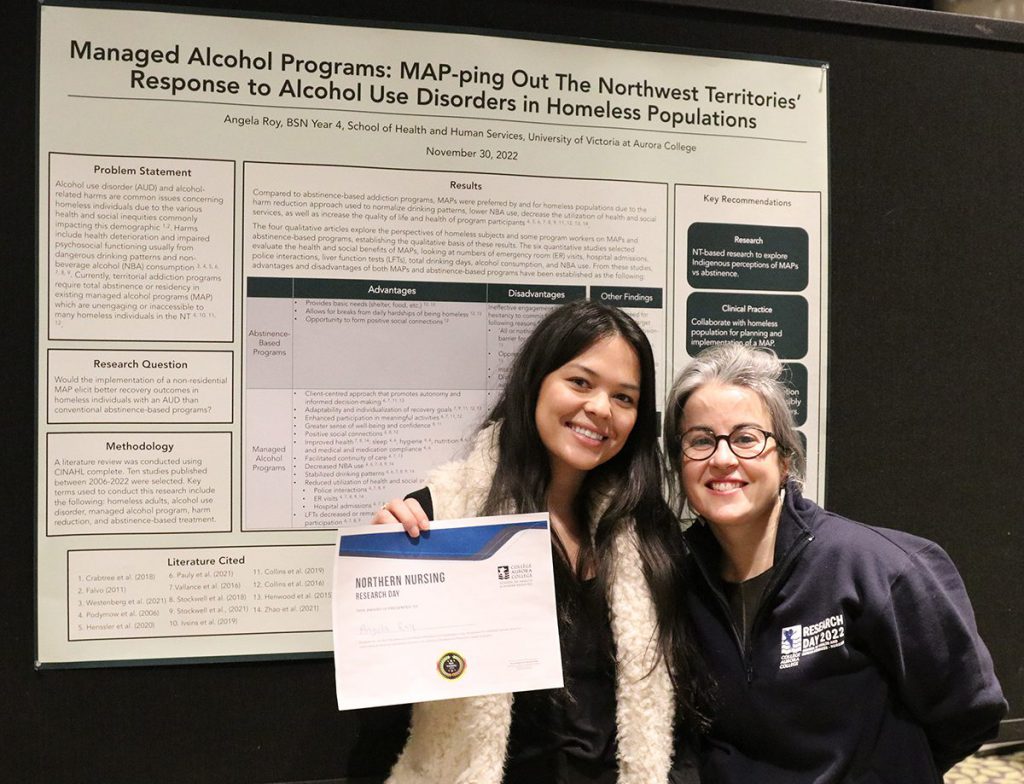
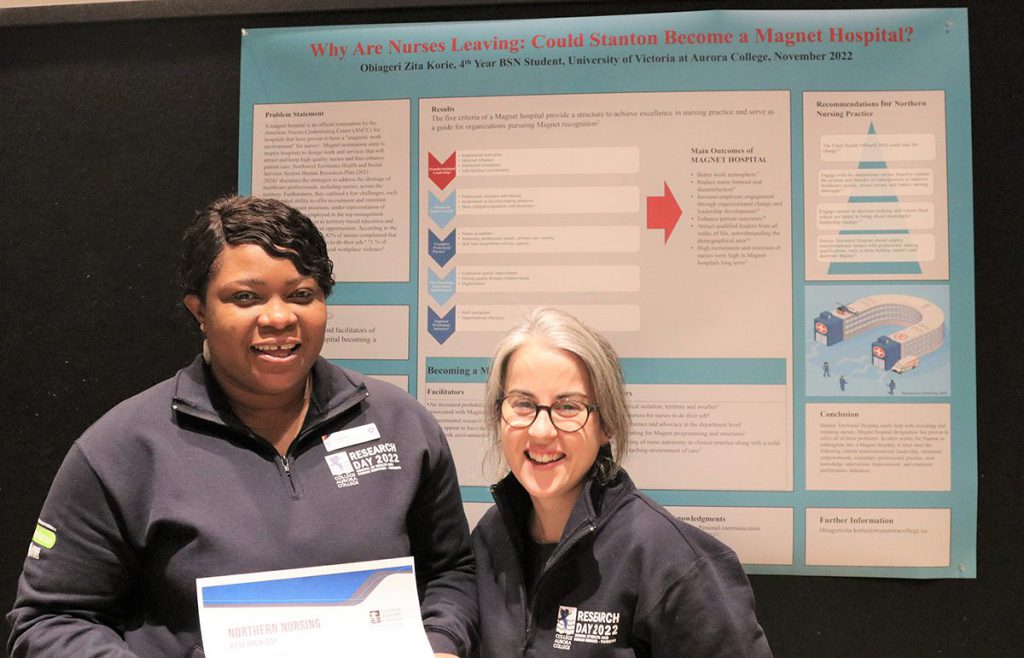
YELLOWKNIFE, NT – Aurora College Bachelor of Science in Nursing (BSN) students and faculty celebrated and shared their knowledge at the annual Northern Nursing Research Day, held on November 30. The School of Health and Human Services Research Day is an opportunity to showcase and honour scholarship and academic work of students, faculty and invited scholars, and to celebrate student success
.
This year, the event was hosted by Aurora College and Hotıì ts’eeda. A total of 23 posters were featured – 19 literature review researches from fourth-year BSN students and four research projects led by the faculty.
Guest speakers shared information about cultural safety and safe nursing practice, as well as how to implement the United Nations Declaration on the Rights of Indigenous Peoples in health research and services in the North.
The theme of this year’s Research Day was “Clinical Safety in our Northern Context” and was divided into three broad areas: Moving Towards Health Equity; Supporting Nursing Education & Workforce; and Clinical Innovations for Nursing Practice. The topics chosen for the research posters and the unique approaches taken by the students underscore the importance of developing and applying research that is for the North, by the North and with the North, to improve the quality of care and to prioritize decolonizing approaches to advance nursing knowledge.
Three awards were presented to students at the event:
Creativity Award – Angela Roy for Managed Alcohol Programs: MAP-ping Out the NWT’s Response to Alcohol Use Disorders in Homeless Populations;
Scientific Rigour Award – Brook Dwyer for Colorectal Cancer in Indigenous Peoples: A Call to Action; and
People’s Choice Award – Obiageri Zita Korie for Why Are Nurses Leaving: Could Stanton Become a Magnet Hospital?
The research projects are the culmination of the fourth-year students’ Nursing Research course. The intent of the course is to increase understanding of nursing scholarship and enhance the students’ ability to comprehend, critique and utilize nursing research. To create the final product, students developed a research question, search and collected literature and evidence, appraised the evidence, organized their findings, and then created recommendations for the clinical, research, education, and/or policy level, applicable to a northern context.
Students were also invited by Hotıì ts’eeda to display their research posters again for the Dene Nation during their leadership meetings on December 14. Check out their research posters here.
— 30 —
Quotes:
“Colorectal cancer is the second most common cancer to cause mortality in Indigenous Peoples and is under reported in Indigenous Peoples in the North. It is important to collect this data to find ways to reduce these incidences. Northern research is imperative to reduce the current inequities and disparities amongst this population.”
– Brooke Dwyer, Bachelor of Science in Nursing student, recipient of Scientific Rigour Award
“Northern-based research is key for inclusivity and cultural safety as it relates to Indigenous communities. The variations in the territory’s population (ethnicity, culture, age, geography) require special consideration to ensure any interventions are suitable; the rurality of the NWT makes it difficult to generalize and apply findings from other studies; and Indigenous Peoples deserve recognition in the research domain if findings are to be applied to them.”
– Angela Roy, Bachelor of Science in Nursing Student, recipient of Creativity Award
“My research focused on Magnet Hospitals and their ability to attract high-quality health professionals, improve patient outcomes and retain hired nurses. Magnet hospitals create structures that involve nurses in decision-making, policies and research – ensuring that nurses have all the resources to do their jobs. The current rate of nurses leaving bedside care globally and in the NWT threatens the health care system, patient safety, quality of patient care and nurse retention.”
– Obiageri Zita Korie, Bachelor of Science in Nursing student, recipient of Peoples’ Choice Award
YELLOWKNIFE, TNO – Les étudiants au baccalauréat en sciences infirmières et les enseignants du Collège Aurora ont célébré et partagé leurs connaissances lors de la Journée annuelle de recherche nordique sur les soins infirmiers, qui a eu lieu le 30 novembre. La journée de la recherche de l’École des services de santé et des services sociaux est l’occasion de mettre en valeur et d’honorer les travaux de recherche et les travaux universitaires des étudiants, des professeurs et des chercheurs invités, et de souligner la réussite des étudiants.
Cette année, l’événement était organisé par le Collège Aurora et Hotıì ts’eeda. Au total, 23 affiches ont été présentées, dont 19 recherches par analyse documentaire effectuées par des étudiants en quatrième année du baccalauréat en sciences infirmières et quatre projets de recherche menés par le corps enseignant.
Les conférenciers invités ont partagé des informations sur la sécurité culturelle et la pratique sûre des soins infirmiers, ainsi que sur la manière de mettre en œuvre la Déclaration des Nations Unies sur les droits des peuples autochtones dans la recherche et les services de santé du Nord.
Cette année, le thème de la Journée de la recherche était « La sécurité clinique dans notre contexte nordique », thème divisé en trois grands volets : Vers l’équité en santé, Soutenir l’éducation et la main-d’œuvre infirmières et Innovations cliniques pour la pratique infirmière. Les sujets choisis pour les affiches de recherche et les approches uniques adoptées par les étudiants soulignent l’importance de développer et d’appliquer une recherche pour le Nord, par le Nord et avec le Nord, afin d’améliorer la qualité des soins et de privilégier les approches décolonisatrices pour faire progresser les connaissances dans le domaine des soins infirmiers.
Trois prix ont été remis à des étudiants lors de l’événement :
Prix de la créativité – Angela Roy pour Managed Alcohol Programs: MAP-ping Out the NWT’s Response to Alcohol Use Disorders in Homeless Populations (Programmes de gestion de l’alcool : Cartographie de la réponse des TNO aux troubles de la consommation d’alcool chez les itinérants);
Prix de la rigueur scientifique – Brook Dwyer pour Colorectal Cancer in Indigenous Peoples: A Call to Action (Le cancer colorectal chez les peuples autochtones : Un appel à l’action);
Prix Choix du public – Obiageri Zita Korie pour Why Are Nurses Leaving: Could Stanton Become a Magnet Hospital? (Pourquoi le personnel infirmier part : Stanton pourrait-il devenir un hôpital magnétique?)
Les projets de recherche sont l’aboutissement du cours de recherche en soins infirmiers des étudiants de quatrième année. L’objectif de ce cours est de mieux comprendre la recherche en soins infirmiers et d’améliorer la capacité des étudiants à comprendre, critiquer et utiliser cette recherche. Pour créer le produit final, les étudiants ont développé une question de recherche, ont examiné la documentation et les données probantes, ont évalué les données probantes, ont organisé leurs résultats et ont ensuite formulé des recommandations pour le niveau clinique, la recherche, l’éducation ou les politiques, applicables au contexte nordique.
Les étudiants ont également été invités par Hotıì ts’eeda à exposer à nouveau leurs affiches de recherche pour la Nation dénée lors de leur réunion avec les leaders le 14 décembre. Consultez les affiches de recherche ici.
— 30 —
Citations
« Le cancer colorectal est le deuxième cancer le plus fréquent à causer la mortalité chez les peuples autochtones et il est sous-déclaré chez les peuples autochtones du Nord. Il est important de recueillir ces données pour trouver des moyens de réduire le nombre de cas. La recherche nordique est impérative pour réduire les inégalités et les disparités actuelles au sein de cette population. »
– Brooke Dwyer, étudiante au baccalauréat en sciences infirmières, récipiendaire du Prix de la rigueur scientifique
« La recherche axée sur le Nord est essentielle pour l’inclusion et la sécurité culturelle des communautés autochtones. Les différences au sein de la population du territoire (ethnicité, culture, âge, géographie) nécessitent une attention particulière pour s’assurer que toute intervention est appropriée; la ruralité des TNO rend difficile la généralisation et l’application des résultats d’autres études, et les peuples autochtones méritent d’être reconnus dans le domaine de la recherche si les résultats leur seront appliqués. »
– Angela Roy, étudiante au baccalauréat en sciences infirmières, récipiendaire du Prix de la créativité
« Mes recherches ont porté sur les hôpitaux magnétiques et leur capacité à attirer des professionnels de la santé de hautement compétents, à améliorer les résultats des patients et à maintenir le personnel infirmier en poste. Les hôpitaux magnétiques créent des structures qui font participer le personnel infirmier à la prise de décision, aux politiques et à la recherche, en veillant à ce que le personnel infirmier dispose de toutes les ressources nécessaires pour faire son travail. Le taux actuel d’infirmières et d’infirmiers qui quittent les soins de chevet dans le monde et aux TNO menace le système de soins de santé, la sécurité des patients, la qualité des soins aux patients et la rétention du personnel infirmier. »
– Obiageri Zita Korie, étudiante au baccalauréat en sciences infirmières, récipiendaire du Prix Choi du public
Aurora College one of Canada’s top 50 Research Colleges for seventh year
La version française suit le texte anglais.
INUVIK, NT – Aurora College was recognized by Research Infosource Inc. as one of Canada’s Top 50 Research Colleges for 2022. Aurora College was ranked #42 overall among the nation’s top research colleges. This is the seventh consecutive year that Aurora College has ranked within the country’s top 50 research colleges.
Among small colleges – defined as having an annual income of less than $75 million – Aurora College is ranked #3 in both SSHRC Research Income and SSHRC Research Income as a Percentage of Total Research Income, is #10 for NSERC Research Income and #7 for NSERC Research Income as a Percentage of Total Research Income. SSHRC (Social Sciences and Humanities Research Council) and NSERC (Natural Sciences and Engineering Research Council) are two of the three major federal research funding bodies in Canada for post-secondary institutions.
Aurora College also ranked #9 out of small colleges for Canadian Foundation for Innovation (CFI) Research Income and CFI Research Income as a Percentage of Total Research Income. For research dollars per researcher – research intensity – Aurora College was ranked #28 out of all colleges in Canada.
The Top 50 Research Colleges rankings are determined by evaluating research income, number of research staff, number of students participating in research projects, number of research partnerships, and number of completed and on-going research projects.
Research projects in which Aurora College leads or is involved in include the areas of physical sciences, social sciences, health, contaminants, biology, Traditional Knowledge and engineering. Current research projects include: permafrost monitoring; the effects of climate change on the northern landscape, environment, flora, fauna and ways of life; air quality monitoring; renewable energy; Northern and Indigenous health care; soil safety; geographic information systems (GIS) mapping and monitoring; traditional uses of plant species; and various youth outreach projects in science, technology, engineering and mathematics (STEM).
For more information and a complete list of Canada’s top 50 research colleges 2022, visit: https://researchinfosource.com/top-50-research-colleges/2022
Quotes:
“Each year Aurora College continues to grow areas of research and encourages researchers from other parts of Canada and from international sites to participate in the North. The NWT has an incredibly vibrant and diverse research community with deep ties to Northern land, tradition, community and people. Aurora College will continue encouraging and supporting Northern research of high quality and relevance, as well as providing applied learning experiences to students as it transforms into a polytechnic university. It is essential that research completed in the North is for the benefit of its Northern people.”
– Dr Glenda Vardy Dell, President, Aurora College
— 30 —
Aurora College delivers academic upgrading, trades and industrial training, certificate, diploma and degree programs to more than 3,000 full and part-time students at three campuses, 21 Community Learning Centres and other community sites in the Northwest Territories. Community-centred post-secondary programs reflect Northern culture and the needs of the Northern labour market. Aurora College’s research division, Aurora Research Institute, conducts, supports, and licenses research in the NWT. Research centres are located in Inuvik, Yellowknife and Fort Smith.
For more information, please contact:
Jayne Murray
Manager, Communications & College Relations
Aurora College
Phone: 867-872-7021
Email: jmurray@auroracollege.nt.ca
POUR DIFFUSION IMMÉDIATE
26 janvier 2023
Le Collège Aurora figure dans la liste des 50 meilleurs collèges de recherche au Canada pour la septième année consécutive
Inuvik, TNO – Research Infosource Inc. a reconnu le Collège Aurora comme l’un des 50 meilleurs collèges de recherche au Canada en 2022. Le Collège Aurora se hisse à la 42e place des meilleurs collèges de recherche du pays. C’est la septième année consécutive que le Collège Aurora se classe parmi les 50 meilleurs collèges de recherche du Canada.
Parmi les petits collèges (définis comme ayant un revenu annuel inférieur à 75 millions de dollars), le Collège Aurora se classe au troisième rang pour les revenus de recherche du Conseil de recherches en sciences humaines du Canada (CRSH) et les revenus de recherche du CRSH en tant que pourcentage des revenus totaux de recherche, au dixième rang pour les revenus de recherche du Conseil de recherches en sciences naturelles et en génie (CRSNG) et au septième rang pour les revenus de recherche du CRSNG en tant que pourcentage des revenus totaux de recherche. Le CRSH et le CRSNG sont deux des trois principaux organismes fédéraux de financement de la recherche au Canada pour les établissements postsecondaires.
Le Collège Aurora s’est également classé au neuvième rang parmi les petits collèges pour les revenus de recherche de la Fondation canadienne pour l’innovation (FCI) et pour les revenus de recherche de la FCI en pourcentage des revenus totaux de recherche. En ce qui concerne les sommes consacrées à la recherche par chercheur (l’intensité de la recherche), le Collège Aurora se classe au 28e rang parmi tous les collèges du Canada.
Le classement des 50 meilleurs collèges de recherche est déterminé par l’évaluation des revenus de recherche, du nombre de membres du personnel de recherche, du nombre d’étudiants participant aux projets de recherche, du nombre de partenariats de recherche, et du nombre de projets de recherche conclus et en cours.
Le Collège Aurora mène des projets de recherche dans les domaines des sciences physiques, des sciences sociales, de la santé, des polluants, de la biologie, du savoir traditionnel et de l’ingénierie, en plus d’y participer. Les projets actuels comprennent la surveillance du pergélisol; les effets du changement climatique sur le paysage, l’environnement, la flore, la faune et les modes de vie nordiques; la surveillance de la qualité de l’air; l’énergie renouvelable; les soins de santé axés sur le Nord et destinés aux Autochtones; la sécurité des sols; la surveillance et la cartographie des systèmes d’information géographique (SIG); les utilisations traditionnelles des espèces végétales indigènes; et divers projets d’enseignement en sciences, en technologie, en ingénierie et en mathématiques (STIM) auprès des jeunes Ténois.
Pour en savoir plus et consulter la liste complète des 50 meilleurs collèges de recherche au Canada en 2022, rendez-vous au https://researchinfosource.com/top-50-research-colleges/2022.
Citation
« Chaque année, le Collège Aurora continue de développer des domaines de recherche et encourage les chercheurs d’autres régions du Canada et de sites internationaux à participer aux activités du Nord. Les TNO ont une communauté de chercheurs dynamique, diversifiée et profondément liée à ses résidents, ainsi qu’au territoire, aux traditions, et aux collectivités nordiques. Le Collège Aurora continuera d’encourager une recherche ténoise pertinente et de qualité et de lui apporter son soutien, et de fournir aux étudiants l’occasion d’appliquer directement leurs apprentissages tout au long de la transformation du Collège en une université polytechnique. Il est essentiel que les recherches effectuées dans le Nord profitent à ses résidents. »
– Glenda Vardy Dell (Ph. D.), présidente du Collège Aurora
Conference Board of Canada Releases Report Highlighting Polytechnic University Benefits
YELLOWKNIFE (January 24, 2023) The Conference Board of Canada has released a report that highlights the benefits of a polytechnic university for the Northwest Territories (NWT) and its residents.
The report, Investing in Polytechnic Education in the Northwest Territories, is built on research and engagement led by Conference Board of Canada. It describes what a polytechnic university can do, highlights some of the benefits and examines how Aurora College can tailor itself in a way that enhances its contribution to the territorial economy.
The Government of the Northwest Territories and Aurora College are committed to ensuring every resident of the NWT has an equitable opportunity to reach their full potential through post-secondary opportunities, and the polytechnic university will help fulfill that commitment. It will be an institution for all NWT residents and the quality of education and student experience offered will meet or exceed the standard set by post-secondary institutions across Canada.
While the report does not identify all activities Aurora College currently has underway in support of transformation, it will be an excellent tool as we continue to seek investment opportunities. The establishment of co-investment partnerships through formal agreements will continue to be essential to the success of transformation and to the long-term development and growth of the polytechnic university. Reports such as the one published by the Conference Board of Canada will support these ongoing efforts.
Quote(s)
“In my role as Minister of Education, Culture and Employment I regularly meet with federal counterparts to discuss post-secondary matters such as the polytechnic university. Combined with existing GNWT and Aurora College strategic documents, this report will support those conversations and our case for continued federal investment in post-secondary education in, and for the North.”
– R.J. Simpson, Minister of Education, Culture and Employment
“External reports such as this one support the work being done by Aurora College and the GNWT to increase and enhance academic opportunities for Northerners at all levels, in all communities. The report also supports the College’s ongoing expansion of high quality, relevant Northern-based research rooted in the land, traditions, communities and peoples of the NWT that Aurora College will continue to promote and connect with expanded applied learning experiences for students.”
– Glenda Vardy Dell, Aurora College President
Related links
Aurora College is Accepting Applications for Board of Governors Members

Aurora College is looking for individuals interested in helping shape the future of post-secondary education in the Northwest Territories, including the transformation of Aurora College into a polytechnic university.
Experience in the following areas is desired:
- Membership on Board of Directors
- Leadership experience in larger organizations
- Financial planning
- Facilities management
- Post-secondary education
- Reconciliation
- An understanding of small or remote communities
- Northern economic development
- Northern social development
- Public policy
The Aurora College Board of Governors will include 10 public members appointed through this nomination process, five of which must be Indigenous residents of the Northwest Territories.
The Board sets the vision and mission for the institution and ensures Aurora College remains effective, efficient and sustainable. Members of the Board receive honorarium of $400 a day and serve for up to a three-year term.
The application deadline is October 25, 2022.
Those interested are encouraged to download the Board of Governors Application and Information Package below.
To nominate a Board Member, please fill out the Board of Governors Nomination Form (also below) and send it to hmeacock@auroracollege.nt.ca when complete.
For more information email hmeacock@auroracollege.nt.ca or call 867-872-7009.
Le Conseil des gouverneurs établit la vision et la mission du collège et veille à son efficacité et sa viabilité. Ses membres reçoivent une rétribution de 400 $ par jour travaillé et remplissent un mandat de trois ans.
Si vous souhaitez contribuer à façonner l’avenir de l’éducation postsecondaire aux Territoires du Nord-Ouest, dont la transformation du collège en université polytechnique, et que vous avez de l’expérience dans l’un des domaines suivants, nous vous invitons à présenter votre candidature :
- Membre d’un conseil des gouverneurs
- Expérience de leadership dans une plus grande organisation
- Planification financière
- Gestion des installations
- Éducation postsecondaire
- Réconciliation autochtone
- Compréhension des collectivités petites ou éloignées
- Développement économique du Nord
- Développement social du Nord
- Politique publique
Le Conseil des gouverneurs du Collège Aurora est composé de dix membres du public, dont cinq doivent être des résidents autochtones des Territoires du Nord-Ouest, qui sont désignés à l’aide du présent processus de sélection.
Le Conseil des gouverneurs établit les ambitions et la mission du collège et veille à son efficacité et sa viabilité. Ses membres reçoivent une rétribution de 400 $ par jour travaillé et remplissent un mandat de trois ans.
La date limite pour présenter une candidature est le 25 octobre 2022.
Si vous souhaitez proposer la candidature d’une personne, remplissez le formulaire de candidature et envoyez-le à l’adresse hmeacock@auroracollege.nt.ca.
Pour en savoir plus à ce sujet ou télécharger le formulaire de candidature, consultez le www.auroracollege.nt.ca, envoyez un courriel à l’adresse hmeacock@auroracollege.nt.ca ou composez le 867-872-7009.
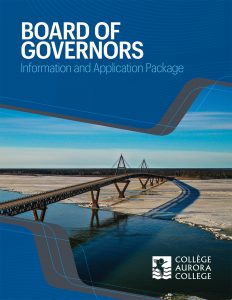
Board of Governors
Information and Application Package
Conseil des gouverneurs
Dossier d’information et de candidature

Board of Governors
Nomination Form

Conseil des gouverneurs
Formulaire de mise en candidature pour le
Gahcho Kué Mine scholarships support top graduates from Early Learning And Child Care program

July 25, 2022
Gahcho Kué Mine scholarships support top graduates from Early Learning And Child Care program
Gahcho Kué Mine and Aurora College are pleased to announce a new scholarship to be awarded to the top 12 Northwest Territories (NWT)-resident graduates of the college’s part-time distance Early Learning and Child Care Program.
The $2,000 scholarships will be awarded annually until 2030. The scholarships support part-time online certificate and diploma graduates who live in the NWT who, because of their part-time status, are ineligible for government funding. Most participants are already working in childcare facilities or in the classroom as assistants in local schools. Gahcho Kué will provide $24,000 annually to support the scholarships, totaling $216,000 over the life of the program.
Recipients of the inaugural award are:
| Farahnaz Abdollarhifar | Yellowknife |
| Nicole Antoine | Fort Simpson |
| Darine Berro | Fort Smith |
| Sheri Coxford | Inuvik |
| Amelia Garcia | Yellowknife |
| Aida Inman | Yellowknife |
| Alex Jones | Fort Smith |
| Natasha Kasook | Tuktoyaktuk |
| Marlo Kiasuk | Inuvik |
| Nicole Klause | Hay River |
| Kandaporn Proulx | Yellowknife |
| Diana Reed | Yellowknife |
The scholarships are part of a larger set of community-based programs that fall under Gahcho Kué Mine’s Building Forever plans. Launched in 2020, Building Forever aims to provide lasting benefits to host communities and includes commitments to protect the natural world, accelerate equal opportunity, partner for thriving communities, and lead ethical practices across industry.
Lyndon Clark, General Manager of Gahcho Kué Mine, said: “We want to congratulate the graduates for completing the program and recognize that each of them plays a critical role in supporting parents and children in their communities. By providing this graduation bursary, we are helping to enhance livelihoods and build an early childhood development network that is essential to thriving communities.”
Glenda Vardy Dell, President of Aurora College, noted: “We are grateful to Gahcho Kué Mine for their recognition of the critical role played by Early Childhood professionals in the development of healthy outcomes for children and families. Providing this financial support is an example of the way partnerships can be created to enhance the quality of life for northern residents and communities.”
Obtaining certificates and diplomas in Early Learning and Child Care will enhance and expand career opportunities for the graduates, including upgraded or additional professional responsibilities, improved pay and opportunities for new or better positions.
The contribution from Gahcho Kué dovetails with the new federal government’s multi-year commitment to invest in early learning and childcare. According to the government of Canada website, “Investing in early learning and childcare offers a jobs-and-growth hat-trick: it provides jobs for workers, the majority of whom are women; it enables parents, particularly mothers, to reach their full economic potential; and it creates a generation of engaged and well-prepared young learners.”
The website also states that “Early learning is at least as important to lifelong development as elementary, secondary and post-secondary education – it improves graduation rates, promotes lifelong well-being, boosts lifetime earnings, and increases social equity….Early learning and childcare programs designed by and with Indigenous families and communities give Indigenous children the best start in life. It is a critical part of reconciliation.”
Gahcho Kué Mine is a joint venture between De Beers Group and Mountain Province Diamonds. The mine is located 280 km northeast of Yellowknife, capital of Canada’s Northwest Territories. Gahcho Kué has a life of mine through 2030.
CONTACT
Terry Kruger
Sr. Communications Officer
De Beers Group Managed Operations – Canada
T +1 867 679 6431
Mob +1 403 835 5875
E-mail: terry.kruger@debeersgroup.com
-30-
About De Beers Group
De Beers Group is a member of the Anglo American plc group. Established in 1888, De Beers Group is the world’s leading diamond company with expertise in the exploration, mining and marketing of diamonds. Together with its joint venture partners, De Beers Group employs more than 20,000 people across the diamond pipeline and is the world’s largest diamond producer by value, with mining operations in Botswana, Canada, Namibia and South Africa. As part of the company’s operating philosophy, the people of De Beers Group are committed to ‘’ by making a lasting contribution to the communities in which they live and work, and transforming natural resources into shared national wealth. For further information about De Beers Group, visit www.debeersgroup.com.
About Mountain Province Diamonds
Mountain Province Diamonds is a 49% participant with De Beers Canada in the Gahcho Kué diamond mine located in Canada’s Northwest Territories. The Gahcho Kué Joint Venture property consists of several kimberlites that are actively being mined, developed, and explored for future development. The Company also controls 106,202 hectares of highly prospective mineral claims and leases that surround the Gahcho Kué Joint Venture property that include an indicated mineral resource for the Kelvin kimberlite and inferred mineral resources for the Faraday kimberlites.