Search

Indigenous Knowledge Holders Council shares Framework document for 2025-2028

July 7, 2025

Indigenous Knowledge Holders Council shares Framework document for 2025-2028

FORT SMITH, NT – Aurora College’s Indigenous Knowledge Holders Council (IKHC) has released its first Framework document – Flowing Waters Framework – which will guide the Council’s work from July 2025 through to June 2028 and will be implemented over the next three academic years.

The document highlights the Indigenous Knowledge (IK) Guiding Principles and the priorities of IKHC, identifies the current council governance, and provides an implementation infographic to illustrate IKHC’s short, medium, and long-term goals during the 2025 to 2028 timeframe.

IKHC’s key responsibility is to guide Aurora College in its Reconciliation journey by providing the necessary wisdom to weave Indigenous ways of knowing, doing, being, and believing into policies, programs, and operations, while also building stronger relationships with students, faculty, staff, and community.

Capturing Indigenous ways of knowing, doing, being and believing into words and in a legislated framework presented Council members with a profound challenge, as these knowledge systems are deeply rooted in lived experiences, oral traditions, and relationships with the land, which often transcend linear or written expressions.

Despite the challenges, using words and frameworks to capture Indigenous ways of knowing remain essential to foster understanding, collaboration, and integration within broader institutional contexts. While challenging, these efforts provide a bridge to share knowledge, inspire dialogue, and create spaces where Indigenous perspectives can shape policies and practices in meaningful ways.

The IKHC’s priorities reflect the Indigenous Knowledge guiding principles and a desire to be rooted in a broad, conceptual simplicity that aligns with ‘four’ as a sacred number, for a variety of reasons, and on ways of knowing, doing, being and believing through metaphor and story. They include:

    • Sacred Places;
    • Indigenizing Education and Cultural Knowledge Continuity;
    • Love and Respect;
    • Leaders in Partnership.
  • Guiding Principles
    • Relationships and Reciprocity
    • NWT Indigenous Culture
    • NWT Indigenous Languages
    • NWT Indigenous Elders
    • NWT Indigenous Curriculum
    • The Land
    • Wellness and Ceremony
    • Strong Like Two People

Aurora College’s IKHC was appointed by the Board of Governors in March 2024, and held its inaugural meeting in Yellowknife in May 2024. The thirteen members are Northwest Territories residents of Dene, Inuvialuit, Métis, and Cree ancestry from across the territory who have been involved in leadership and education, as well as in revitalizing Indigenous languages, cultures, and traditions.

Quotes:

The Indigenous Knowledge Holders Council is proud of the work that got us to this point. We believe this Flowing Waters Framework will guide us in our work, in our connections to our sacred surroundings, to each other and to learn about ourselves. We raise our hands to all the efforts of people that helped shape this pathway. We are honoured to continue our strong traditions but also to endeavour in the careful process of planning and visioning for the College and all the peoples walking their own educational pathways.

Dëneze Nakehk’o, Chair, Aurora College Indigenous Knowledge Holders Council

The establishment of the Indigenous Knowledge Holders Council aligns with the Truth and Reconciliation Commission’s recommendations and underlines Aurora College’s commitment to incorporate Indigenous perspectives and values, and to foster an educational environment that respects Indigenous ways of life, knowledge, cultures, and worldviews.

Dr. Angela James, President, Aurora College

Indigenous Knowledge Holders Council Flowing Waters Framework 2025


Le 7 juillet 2025

Le Conseil des détenteurs du savoir traditionnel présente son document-cadre pour 2025-2028

Fort Smith, TNO – Le Conseil des détenteurs du savoir traditionnel (CDST) du Collège Aurora a publié son premier document-cadre, qui orientera les travaux du Conseil de juillet 2025 à juin 2028 et sera mis en œuvre au cours des trois prochaines années scolaires.

Ce document-cadre fait état des principes directeurs relatifs aux connaissances autochtones (CA) et des priorités du CDST, définit la structure de gouvernance actuelle du Conseil et fournit une infographie illustrant la mise en œuvre des objectifs à court, moyen et long terme du CDST de 2025 à 2028.

La principale responsabilité du CDST est d’orienter le Collège Aurora dans son parcours de réconciliation en lui apportant des conseils judicieux qui l’aideront à intégrer les modes de connaissance des Autochtones ainsi que leurs façons de faire, d’être et de croire dans les politiques, les programmes et les opérations du collège, tout en établissant des relations plus solides avec les étudiants, le corps enseignant, le personnel et les collectivités.

Les membres du Conseil ont été confrontés à un défi de taille au moment de traduire en mots les modes de connaissances des Autochtones ainsi que leurs façons de faire, d’être et de croire et de les intégrer dans un cadre législatif, car ces systèmes de connaissance sont profondément ancrés dans les expériences vécues, les traditions orales et les liens avec la terre, qui transcendent souvent les expressions linéaires ou écrites.

Malgré les difficultés, l’utilisation de mots et de cadres reste essentielle pour mieux saisir les modes de connaissance autochtones, favoriser leur intégration dans des contextes institutionnels plus larges et renforcer la collaboration. Ces efforts permettent de partager les connaissances, de susciter un dialogue et de créer des espaces où les points de vue autochtones peuvent façonner les politiques et les pratiques.

Les priorités du CDST tiennent compte des principes directeurs relatifs aux connaissances autochtones et témoignent du désir de s’enraciner dans une simplicité conceptuelle élargie alignée, pour diverses raisons, sur le « quatre » en tant que nombre sacré et sur les façons de faire, d’être, de croire et d’accéder au savoir grâce à des métaphores et des récits. Il s’agit notamment :

    • Des lieux sacrés
    • De l’adaptation de l’éducation aux cultures autochtones et de la continuité culturelle autochtone
    • De l’amour et du respect
    • Du leadership dans les partenariats
  • Principes directeurs
    • Relations et réciprocité
    • Cultures autochtones des TNO
    • Langues autochtones des TNO
    • Aînées autochtones des TNO
    • Programme d’études autochtone des TNO
    • Terres ancestrales
    • Mieux-être et cérémonies
    • La force de deux peuples

Les membres du CDST du Collège Aurora ont été nommés par le Conseil des gouverneurs en mars 2024, et ont tenu leur réunion inaugurale, à Yellowknife, en mai 2024. Les treize membres sont des résidents d’ascendance dénée, inuvialuite, métisse et crie de partout aux TNO, qui se consacrent depuis de nombreuses années à des activités de leadership et d’éducation, ainsi qu’à la revitalisation des langues, des cultures et des traditions autochtones.

Citations

Le Conseil des détenteurs du savoir traditionnel est fier du travail accompli jusqu’ici. Nous pensons que le cadre intitulé Flowing Waters (eaux vives) nous guidera dans notre travail, raffermira nos liens avec notre environnement sacré et solidifiera nos relations les uns avec les autres, tout en nous permettant d’en apprendre davantage sur nous-mêmes. Nous saluons les efforts des personnes qui ont contribué à défricher ce chemin. Nous sommes honorés de perpétuer nos riches traditions, tout en mettant en place un processus rigoureux de planification et de définition d’une vision pour le Collège et toutes les personnes qui suivent leur propre parcours éducatif.

Dëneze Nakehk’o, président, Conseil des détenteurs du savoir traditionnel du Collège Aurora

La mise en place du Conseil des détenteurs du savoir traditionnel répond aux recommandations de la Commission de vérité et réconciliation et souligne l’engagement du Collège Aurora à intégrer les perspectives et les valeurs autochtones ainsi qu’à favoriser un environnement éducatif qui respecte les modes de vie, les connaissances, les cultures et les visions du monde autochtones.

Angela James, présidente du Collège Aurora

Indigenous Knowledge Holders Council Flowing Waters Framework 2025
New Aurora College Board of Governors Chairperson Appointed

May 15, 2025

New Aurora College Board of Governors Chairperson Appointed

YELLOWKNIFE, NT – The Government of the Northwest Territories (GNWT) has appointed Kenny Ruptash to the Aurora College Board of Governors and named him Chairperson of the Board for a three-year term. A long-time Northerner and respected leader in governance and industry, Mr. Ruptash brings over two decades of private and public sector experience, including roles on the boards of financial institutions, economic development corporations, and publicly traded companies.

This appointment comes at a pivotal time in Aurora College’s ongoing transformation into a polytechnic university. With the 2025–2028 Aurora College Mandate Agreement as its guide, this transformation is laying the foundation for a post-secondary institution that is reflective of Northern priorities, responsive to labour market needs, and built on partnerships with Indigenous governments and communities.

Mr. Ruptash’s leadership will help the Board of Governors strengthen Aurora College’s independent governance model, while ensuring the institution delivers on its core commitments: expanding high-quality academic programming, launching its first degree, advancing research, improving infrastructure, and enhancing access to education and training opportunities across all regions of the Northwest Territories.

Quotes:

“Aurora College is a key driver of sustainable economic development in the Northwest Territories, and our government is committed to ensuring it evolves and succeeds. With his deep Northern roots, business expertise, and governance experience, Mr. Ruptash is the right person to lead the Board at this critical time. The GNWT is committed to working with the Board to support the College’s transformation into a global leader in northern education that is shaped by the NWT’s priorities and ready to deliver new opportunities for future generations. “

– Caitlin Cleveland, Minister of Education, Culture and Employment

“It’s a privilege to serve as Chair at such a pivotal time in Aurora College’s transformation. The work done by the Board to date has created a strong platform for the polytechnic transition, and I look forward to working with my colleagues on the Board and with College staff to deliver on the objectives set out in the Mandate Agreement. Aurora College is well positioned to become a cornerstone of Northern development by aligning its programs with the needs of the North.”

– Kenny Ruptash, Chairperson, Aurora College Board of Governors

Quick Facts

  • The Aurora College Mandate Agreement 2025–2028 sets out a clear roadmap for transformation, including:
    • Transitioning to a polytechnic university by 2027
    • Strengthening governance through an arm’s-length, tricameral structure comprising the Board of Governors, Academic Council, and Indigenous Knowledge Holders Council
    • Launching the College’s first fully developed, quality-assured degree program
    • Advancing academic and research excellence
    • Enhancing infrastructure and expanding programming across the territory
    • Reinforcing partnerships with Indigenous governments, communities, and stakeholders
  • Mr. Ruptash currently serves as President of the NWT and Nunavut Chamber of Mines and has held senior governance roles with Prosper NWT and the Métis Dene Development Fund.
  • Aurora College is currently undergoing a rigorous institutional quality assurance process through the Campus Alberta Quality Council, an essential step toward its designation as a polytechnic university.

Aurora College celebrates 30 years of Nursing Education during National Nursing Week, May 12-18, 2025

May 12, 2025

Aurora College celebrates 30 years of Nursing Education during National Nursing Week, May 12-18, 2025

YELLOWKNIFE, NT – Every year during National Nursing Week, Aurora College recognizes the dedication of nursing students, graduates, faculty, staff and community partners who work together to support and strengthen the nursing profession across the Northwest Territories.

In 2025, Aurora College is celebrating 30 years of delivering Northern nursing education. For three decades, our programs have prepared graduates to become registered nurses who provide culturally relevant, compassionate, skilled care in health facilities across the Northwest Territories and beyond.

This year’s National Nursing Week theme is especially poignant: The Power of Nurses to Transform Health. The theme highlights the impact nurses have to shape health care, drive innovation and advocate for patient-centred care. National Nursing Week recognizes the hard work and dedication of nurses across Canada and around the world.

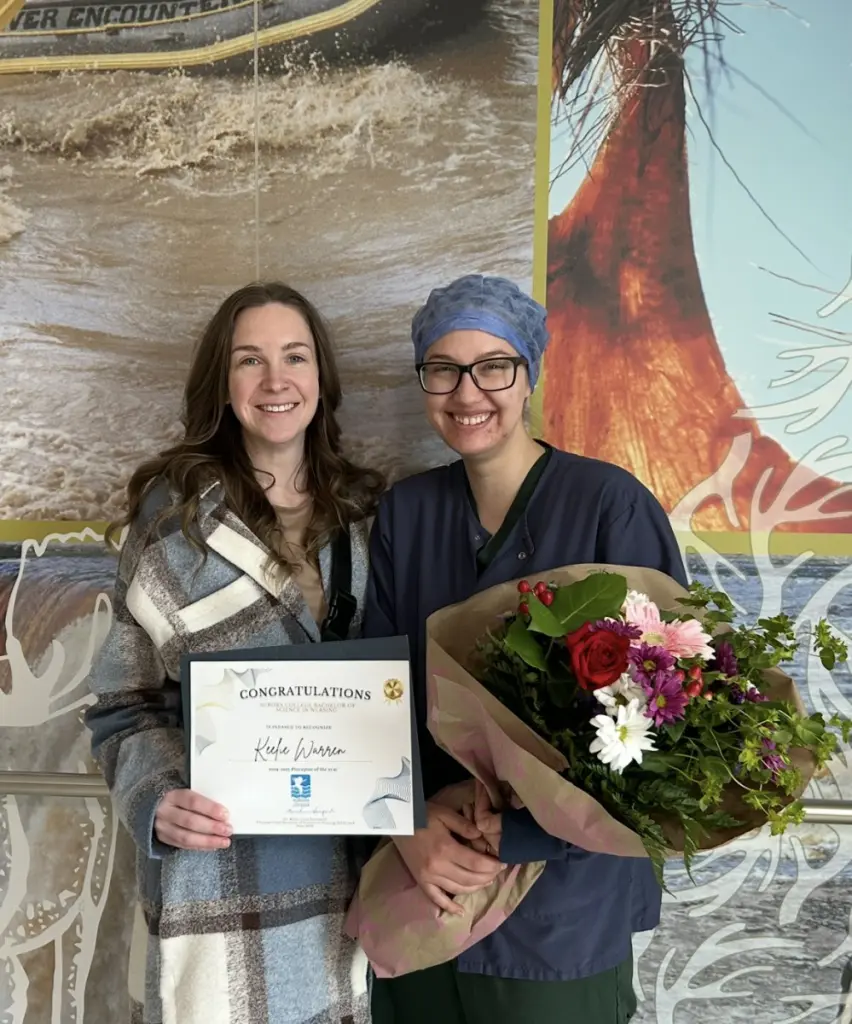
Every year during National Nursing Week in May, Aurora College recognizes the dedication of nursing students, graduates, faculty, staff and community partners who work together to support and strengthen the nursing profession across the Northwest Territories. this year, the Bachelor of Science in Nursing program honoured Keelie Warren with the BSN Preceptor of the Year award. Keelie Warren is celebrated for demonstrating excellence in teaching and learning; going above and beyond expectations in promoting student learning and achievement; and serving as an outstanding role model for registered nursing practice. She is also a proud alumnus of Aurora College’s BSN program!

Aurora College’s four-year Bachelor of Science in Nursing (BSN) is offered in partnership with the University of Victoria, and offers a unique Northern and Indigenous focus that prepares graduates to work in Northern and remote health care settings.

Aurora College also offers a two-year Practical Nurse (PN) Diploma program, which prepares graduates to become Licensed Practical Nurses. This is an excellent option for nursing education that now exists in the NWT to help meet health system needs for individuals, families and communities.

Quote:

For 30 years, Aurora College has helped shape the next generations of registered nurses in the North. Our BSN and PN graduates are integral to the Northern health care system not only as caregivers but as community leaders, healthcare advocates, and highly respected professionals in demand across the territory.”

– Jodi Brennan, Chair, School of Health and Human Services, Aurora College.

Nurses are the heart of all of our NWT communities and we are proud that so many began their journey by studying at Aurora College. As we mark 30 years of nursing education and National Nursing Week, we thank all of our nurses who have been on the frontlines to contribute to the wellbeing of northerners.”

– Dr. Angela James, President, Aurora College


le 12 mai, 2025

Le Collège Aurora célèbre 30 ans de formation infirmière pendant la Semaine nationale des soins infirmiers, du 12 au 18 mai 2025!

Yellowknife, Territoires du Nord-Ouest – Chaque année, pendant la Semaine nationale des soins infirmiers, le Collège Aurora souligne le dévouement des étudiants en soins infirmiers, de ses diplômés, de son corps enseignant, de son personnel et des partenaires communautaires qui travaillent ensemble pour soutenir et renforcer la profession infirmière dans l’ensemble des Territoires du Nord-Ouest (TNO).

En 2025, le Collège Aurora célèbre 30 ans d’enseignement des soins infirmiers dans le Nord. Pendant trois décennies, nos programmes ont préparé des diplômés à devenir des infirmiers autorisés qui offrent avec compassion des soins de haute qualité adaptés à la culture dans des établissements de santé partout aux TNO et ailleurs.

Cette année, le thème de la Semaine nationale des soins infirmiers est particulièrement émouvant : Le pouvoir des infirmières et infirmiers de transformer la santé. Ce thème souligne le pouvoir des infirmiers de façonner les soins de santé, de propulser l’innovation et de défendre les soins axés sur les patients. La Semaine nationale des soins infirmiers reconnaît le travail acharné et le dévouement des infirmiers partout au Canada et dans le monde.

En partenariat avec l’Université de Victoria, le Collège Aurora offre un baccalauréat en sciences infirmières de quatre ans tout à fait unique. Axé sur une perspective nordique et autochtone,il prépare les diplômés à travailler dans le Nord et dans des milieux de santé éloignés.

Le Collège Aurora propose également un programme d’infirmier auxiliaire de deux ans, qui prépare les diplômés à devenir des infirmiers auxiliaires autorisés. Il s’agit d’une excellente option en matière de formation en soins infirmiers aux TNO qui permet de répondre aux besoins en santé des individus, des familles et des collectivités.

Citations :

« Depuis 30 ans, le Collège Aurora contribue à former les prochaines générations d’infirmiers autorisés dans le Nord. Nos bacheliers en sciences infirmières et nos infirmiers auxiliaires sont essentiels au système de soins de santé du Nord, non seulement parce qu’ils prodiguent des soins, mais aussi parce qu’ils sont des leaders de la communauté, des défendeurs des soins de santé et des professionnels de la santé hautement respectés, en demande dans l’ensemble des TNO. »

– Jodi Brennan, présidente de l’École de santé et de services sociaux du Collège Aurora

« Les infirmiers sont au cœur de toutes nos collectivités ténoises, et de savoir que plusieurs d’entre eux ont commencé leur parcours en étudiant au Collège Aurora nous remplit de fierté. Alors que nous soulignons 30 ans de formation en soins infirmiers ainsi que la Semaine nationale des soins infirmiers, nous remercions tous nos infirmiers, qui se trouvent aux premières lignes pour contribuer au bien-être des résidents du Nord. »

– Angela James, présidente du Collège Aurora

2025 Edets’seèhdzà Aurora College Research Mentorship Opportunity open for applications

May 6, 2025

2025 Edets’seèhdzà Aurora College Research Mentorship Opportunity open for applications

INUVIK, NT – Aurora College and Hotıì ts’eeda are pleased to announce that the 2025 Edets’seèhdzà Mentorship Opportunity is open for applications until June 15, 2025.

This $20,000 opportunity supports a student from Aurora College’s School of Health and Human Services to engage in health research alongside their academic studies.

In 2025, the selected student will be matched with a research team working on the CIHR funded SPARK Inspiration project.

  • Work as a part-time Research Assistant (10 hours/week for 24 weeks)
  • Gain hands-on experience in northern and community health research
  • Attend a health research conference
  • Participate in a potential community visit focused on community health

Edets’seèhdzà (eh-DEY-tsay-zah) means “stepping forward to challenge yourself” in the Tłı̨chǫ language. There have been five students supported through the Edets’seèhdzà opportunity since its launch in 2019. Research areas have included traditional teachings, Northern focused care and Indigenous health research.

For more information or to apply, visit https://nwtspor.ca/en/programs/individuals/edetsseehdza-research-mentorship

Application inquiries can be directed to Andreanne Robitaille at arobitaille@auroracollege.ca


le 6 mai 2025

Demandes acceptées pour la bourse de mentorat Edets’seèhdzà 2025 du Collège Aurora

INUVIK, TNO – Le Collège Aurora et Hotıì ts’eeda sont heureux d’annoncer que les demandes pour la bourse de mentorat Edets’seèhdzà 2025 peuvent être présentées jusqu’au 15 juin 2025.

Cette bourse de 20 000 $ sera attribuée à un étudiant de l’École des services de santé et des services sociaux du Collège Aurora pour lui permettre d’effectuer des travaux de recherche dans le cadre de ses études.

Pour l’édition de 2025, l’étudiant sélectionné sera mis en relation avec une équipe de recherche qui travaille sur un projet subventionné par le programme Étincelle des Instituts de recherche en santé du Canada (IRSC). Grâce à la bourse de mentorat Edets’seèhdzà, l’étudiant aura l’occasion :

  • de travailler à titre d’adjoint à la recherche (à raison de 10 heures par semaine pendant 24 semaines);
  • d’obtenir de l’expérience pratique dans un contexte nordique et communautaire de recherche dans le domaine de la santé;
  • d’assister à une conférence de recherche en santé;
  • de participer à une éventuelle visite en collectivité axée sur la santé de celle-ci.

Edets’seèhdzà [prononcer eh-dé-tsé-zaa] signifie « aller de l’avant pour se dépasser » en tłįchǫ. Cinq étudiants ont reçu cette bourse depuis sa création en 2019. Les recherches ont notamment porté sur les enseignements traditionnels, les soins axés sur le Nord et la santé des Autochtones.

Pour obtenir de plus amples renseignements ou pour présenter une demande, veuillez visiter le https://nwtspor.ca/en/programs/individuals/edetsseehdza-research-mentorship. Pour en savoir plus sur la présentation des demandes, communiquez avec Andreanne Robitaille à l’adresse arobitaille@auroracollege.ca.

Aurora College investing in Northern applied research

May 5, 2025

Aurora College investing in Northern applied research

YELLOWKNIFE, NT – Aurora College has recently invested $60,000 in research funding for staff, faculty and students at Aurora College. Through the launch of the Internal Grants and Awards program funding, the College is taking significant steps in growing applied research capacity across the Northwest Territories (NWT). Internal research funding is a significant shift from funding external researchers, which has been in place since 1995. The new, competitive program is designed to support applied research initiatives led by Aurora College staff, faculty and students in collaboration with community partners, focusing on critical northern issues such as climate change, Indigenous knowledge, and economic development.

The Aurora College Internal Grants and Awards Program offers four distinct funding streams: Start-up Grants for new researchers and projects, Research Assistant Grants to engage students and community members in research, Student Research Awards for outstanding student participation, and Strategic Grants to foster collaborative research partnerships. In its inaugural year, Aurora College is proud to announce the following projects:

  • Bryce Olson (Instructor, Environment and Natural Resources Technology, Thebacha Campus) received a $10,000 Start-up Grant to purchase a “Spectrophotometer for Water Quality Monitoring.” This funding will enable Aurora College to acquire essential equipment for water quality monitoring and to develop capacity of staff, faculty, students and community collaborators on how to use the equipment.
  • Bryce Olson was also given a $20,000 Student Research Award for “Development of Remotely Operated Drone System.” This award supports the salary of Tyler Nagel, an Environment and Natural Resources Technology student at Thebacha Campus, in developing the system.
  • Mike Palmer (Research Manager, North Slave Research Centre, Yellowknife) received a $10,000 Research Assistant Grant for “Assessing Climate Change Effects to Legacy Mining Landscapes in Northern Canada.” This funding supports the training of a recent graduate to assist ongoing research on climate change impacts on Yellowknife-area lakes.
  • Linh Nguyen (Program Head, Environment and Natural Resources Technology, Thebacha Campus) received a $10,000 Research Assistant Grant for “Collaborative Approaches to Ecosystem Conservation and Resource Management in Northern Communities.” The funding enables hiring a recent graduate to contribute to diverse environmental monitoring and resource management research projects.

The enhanced Aurora College Internal Grants and Awards funding program is guided by the Aurora College Research Advisory Council, comprised of Board of Governors members and area experts. Aurora College is strengthening its Research Services Office to provide comprehensive support to growing the research capacity at the College. These investments underscore the College’s commitment to build northern research capacity and to be a leader for applied research in the North, directly benefiting northern students, Indigenous and northern communities, and the wider science community in Canada.

Quote:

These investments underscore the College’s commitment to build northern research capacity and to be a leader for applied research in the North, directly benefiting northern students, Indigenous and northern communities, and the wider science community in Canada.”


– Chris Paci, Vice President of Research, Aurora College


Le 5 mai 2025

Le Collège Aurora investit dans la recherche appliquée du Nord

Yellowknife, Territoires du Nord-Ouest – Le Collège Aurora a récemment injecté 60 000 $ dans le financement de la recherche pour son personnel, son corps professoral et ses étudiants. En allouant ce financement au programme de subventions et de prix à l’interne, le Collège prend d’importantes mesures pour accroître les capacités de recherche appliquée des Territoires du Nord-Ouest (TNO). La transition d’un modèle de financement de chercheurs externes (en place depuis 1995) à un modèle de financement de la recherche à l’interne représente un changement notable. Compétitif, le nouveau programme est conçu pour appuyer les projets de recherche appliquée menés par le personnel, le corps professoral et les étudiants du Collège Aurora en collaboration avec des partenaires communautaires, et axés sur des enjeux nordiques cruciaux comme le changement climatique, les connaissances autochtones et le développement économique.

Le financement du programme de subventions et de prix à l’interne du Collège Aurora se décline en quatre volets distincts : des subventions de démarrage pour les nouveaux chercheurs et projets; des subventions d’adjoint à la recherche afin de susciter l’intérêt des étudiants et des membres de la communauté pour la recherche; des prix de recherche étudiante qui soulignent la participation remarquable à la recherche d’un étudiant; et des subventions stratégiques pour promouvoir les partenariats de recherche collaborative. Alors que le programme en est à sa première année d’existence, le Collège Aurora est fier d’en présenter les tout premiers lauréats ainsi que leur projet :

  • Bryce Olson, instructeur du Programme de technologie de l’environnement et des ressources naturelles du Campus Thebacha, a reçu une subvention de démarrage de 10 000 $ en vue d’acheter « un spectrophotomètre pour surveiller la qualité de l’eau ». Ce financement aidera le Collège Aurora à acquérir un équipement essentiel à la surveillance de l’eau, et permettra aux membres du personnel et du corps professoral, aux étudiants ainsi qu’aux collaborateurs communautaires d’apprendre à utiliser cet équipement.
  • Bryce Olson a également obtenu un prix de recherche étudiante de 20 000 $ pour « l’élaboration d’un système de drones téléguidés ». Ce prix permettra de verser un salaire à Tyler Nagel, étudiant en technologie de l’environnement et des ressources naturelles du Campus Thebacha, qui contribue à mettre au point le système.
  • Mike Palmer, directeur de la recherche du Centre de recherche du Slave Nord à Yellowknife, s’est vu attribuer une subvention d’adjoint à la recherche de 10 000 $ pour « évaluer les répercussions du changement climatique sur les paysages touchés par d’anciennes activités minières dans le Nord canadien ». Ce financement soutient la formation d’un jeune diplômé qui prendra part à la recherche en cours sur les répercussions du changement climatique sur les lacs de la région de Yellowknife.
  • Linh Nguyen, responsable du Programme de technologie de l’environnement et des ressources naturelles du Campus Thebacha, a touché une subvention d’adjoint à la recherche de 10 000 $ pour élaborer des « stratégies collaboratives visant la conservation des écosystèmes et la gestion des ressources dans les collectivités nordiques ». Ce financement permettra d’embaucher un jeune diplômé qui participera à divers projets de recherche portant sur la surveillance environnementale et la gestion des ressources.

Le programme amélioré de subventions et de prix à l’interne du Collège Aurora est dirigé par le Conseil consultatif de recherche de ce dernier, composé de membres du Conseil des gouverneurs et d’experts du domaine de la recherche. Le Collège renforce son Bureau des services de recherche pour soutenir davantage le développement de ses capacités de recherche. Ces investissements, qui profitent aux étudiants du Nord, aux collectivités autochtones et nordiques ainsi qu’à la communauté scientifique élargie du Canada, illustrent l’engagement du Collège Aurora à renforcer les capacités de recherche nordiques et à être un leader de la recherche appliquée dans le Nord.

Citation

« Ces investissements, qui profitent aux étudiants du Nord, aux collectivités autochtones et nordiques ainsi qu’à la communauté scientifique élargie du Canada, illustrent l’engagement du Collège Aurora à renforcer les capacités de recherche nordiques et à être un leader de la recherche appliquée dans le Nord. »


– Chris Paci, vice-président à la recherche du Collège Aurora

Aurora College awarded $565,000 for STEM Outreach in the NWT

April 28, 2025

Aurora College awarded $565,000 for STEM Outreach in the NWT

FORTH SMITH, NT – The Natural Sciences and Engineering Research Council (NSERC) has awarded Aurora College’s Aurora Research Institute (ARI) two grants totalling $565,000. The funds will go towards providing a wide range of locally- and culturally-relevant opportunities for students and youth to learn about climate change and its impacts on the NWT.

ARI was awarded the NSERC PromoScience organization award for 2024. The NSERC Awards for Science Promotion honour individuals and groups who make an outstanding contribution to the promotion of science in Canada through activities encouraging popular interest in science or developing science abilities.

An additional grant was awarded for a project titled “On-the-Ground Year-Round: Hands-On STEM Outreach for NWT Youth and Educators”. This grant will provide $540,000 in funding over three years and will go towards helping the ARI STEM Outreach team grow capacity to meet the increasing demand for programming, training, and support across the territory.

The two awards represent a substantial investment in the futures of northern youth. Opportunities for youth to engage in hands-on scientific learning are limited in the Northwest Territories (NWT), and consequently, northern youth pursue STEM (science, technology, engineering, math) careers at a lower rate than their southern counterparts. The ARI STEM Outreach Program delivers hands-on STEM learning experiences for youth, and training, equipment, and support for educators to incorporate engaging STEM activities in their teaching. Aurora College will continue foster interest and confidence in the sciences within our communities.

Quote:

“We are thrilled to receive these grants from NSERC PromoScience, which highlights our commitment to providing hands-on STEM learning in the Northwest Territories. The funding will help to propel us into the next stages of this good work.”

– Chris Paci, Vice President of Research, Aurora College

Quick Facts

  • One grant will go towards project “On-the-Ground Year-Round: Hands-On STEM Outreach for NWT Youth and Educators,” which aims to grow the current STEM Outreach Program
  • The other grant will also go towards expanding the capacity for the ARI STEM Outreach Program

Links:


Le 28 avril 2025

Le Collège Aurora reçoit 565 000 $ pour la promotion des STIM aux TNO

FORTH SMITH (TNO) – Le Conseil de recherches en sciences naturelles et en génie (CRSNG) du Canada a accordé deux subventions totalisant 565 000 $ à l’Institut de recherche Aurora (IRA) du Collège Aurora. Ces fonds permettront aux étudiants et aux jeunes de profiter de multiples possibilités pertinentes pour en apprendre davantage sur le changement climatique et ses répercussions sur l’environnement aux Territoires du Nord-Ouest (TNO), tant sur le plan social que culturel.

L’IRA a reçu le Prix du CRSNG pour la promotion des sciences de 2024 dans la catégorie Organisation. Les prix du CRSNG pour la promotion des sciences rendent hommage aux particuliers et aux groupes qui apportent une contribution exceptionnelle à la promotion des sciences au Canada par l’entremise d’activités visant à encourager la population à s’intéresser aux sciences ou à acquérir des aptitudes en sciences.

Une subvention additionnelle a été accordée pour le projet « Sur le terrain, tout au long de l’année : Activités pratiques de sensibilisation aux STIM pour les étudiants, les éducateurs et les communautés des TNO ». Réparti sur trois ans, ce financement de 540 000 $ aidera l’équipe de promotion des STIM de l’IRA à accroître ses effectifs pour répondre à la demande croissante de programmes, de formation et de soutien partout aux TNO.

Ces subventions représentent un investissement important dans l’avenir des jeunes du Nord, pour qui les occasions d’effectuer un apprentissage scientifique pratique aux TNO sont limitées. Par conséquent, les jeunes d’ici sont moins nombreux à poursuivre une carrière dans les STIM (sciences, technologie, ingénierie et mathématiques) que ceux dans le sud du pays. Le Programme de promotion des STIM de l’IRA offre des expériences d’apprentissage pratiques aux jeunes ainsi que des formations, de l’équipement et du soutien aux éducateurs pour qu’ils intègrent à leur enseignement des activités liées aux STIM. Le Collège Aurora continuera de stimuler l’intérêt des jeunes Ténois pour les sciences et de renforcer leur confiance en eux.

Citations

« Nous sommes ravis de recevoir ces subventions du Programme PromoScience du CRSNG! Ceci témoigne de notre engagement à offrir un apprentissage pratique des STIM aux Territoires du Nord-Ouest. Ce financement nous aidera à entreprendre les prochaines étapes de cet important travail. »

– Chris Paci, vice-président de la recherche, Collège Aurora

Faits en bref

  • La première subvention servira à financer le projet « Sur le terrain, tout au long de l’année : Sensibilisation aux STIM pour les étudiants, les éducateurs et les communautés des TNO », qui vise à étendre l’actuel Programme de promotion des STIM de l’IRA.
  • La deuxième subvention servira également à accroître la capacité du Programme de promotion des STIM de l’IRA.

Lien

Aurora College and Northwestel Speaker Series prepares students for job market

April 15, 2025

Aurora College and Northwestel Speaker Series prepares students for job market

YELLOWKNIFE, NT – Aurora College and Northwestel are presenting a new Speaker Series to help prepare post-secondary students to enter the job market. The series will offer tools and insights to build a successful career.

The first of this five-part series, “What Happens After Graduation? Expectation and Career Challenges” took place at Yellowknife North Slave Campus on Saturday, April 12, 2025. Workshop facilitators Janell Dautel and Sarah McClafferty spoke to a group of 14 students about what to expect once they graduate.

The Aurora College Speaker Series powered by Northwestel will continue to take place at Aurora College campuses in Fort Smith, Inuvik and Yellowknife. Future workshops will focus on issues important to students and new professionals, including preparing for career challenges, what to expect in a job market, financial well-being, and mental health.

With programming for college and high school students, with a commitment to Indigenous community and culture, facilitators in the Speaker Series will work with students to ensure they have the best tools and guidance available as they enter the labour market in their chosen fields. These presentations, hands-on activities and cultural/arts workshops will focus on students’ mental, physical, and spiritual health, and emotional wellbeing.

 Quote:

“Providing our students with the best tools and skills available to succeed is a priority for Aurora College. We are proud to be able to help prepare them to succeed both personally and professionally, and we thank Northwestel for their valuable partnership in delivering these workshops.”

– Dr. Angela James, President, Aurora College

“At Northwestel, we’re committed to youth empowerment, mental wellness, and celebrating Indigenous culture. Through our partnership with Aurora College, we’re helping students build the skills and connections needed for success in today’s job market. As one of the North’s largest employers, we look forward to one day welcoming some of these students to our team.”

– Curtis Shaw, President, Northwestel


Le 15 avril 2025

Les conférences du Collège Aurora et de Northwestel préparent les étudiants au marché du travail

Yellowknife, TNO – Le Collège Aurora et Northwestel présentent une nouvelle série de conférences pour préparer les étudiants de niveau postsecondaire à entrer sur le marché du travail. On y proposera des outils et des conseils pour réussir sa carrière.

La première conférence de cette série en cinq parties, intitulée « Que se passe-t-il après l’obtention du diplôme? Attentes et défis professionnels » (What Happens After Graduation? Expectation and Career Challenges), a été organisée sur le campus du Slave Nord à Yellowknife, le samedi 12 avril 2025. Les animatrices de l’atelier, Janell Dautel et Sarah McClafferty, ont expliqué à un groupe de 14 étudiants ce à quoi ils peuvent s’attendre après l’obtention de leur diplôme.

La série de conférences du Collège Aurora, rendue possible par Northwestel, se poursuivra sur les campus du Collège Aurora à Fort Smith, Inuvik et Yellowknife. Les prochains ateliers porteront sur des enjeux importants pour les étudiants et les nouveaux professionnels, notamment la préparation aux défis de carrière, les attentes du marché du travail, le bien-être financier et la santé mentale.

Les conférences s’adressent aux étudiants de niveau collégial et secondaire et tiennent compte de la culture et des collectivités autochtones. Les animateurs travailleront avec les étudiants pour s’assurer qu’ils disposent des meilleurs outils et conseils possibles pour entrer sur le marché du travail dans leur domaine de prédilection. Les présentations, activités pratiques et ateliers culturels et artistiques seront axés sur la santé mentale, physique et spirituelle des étudiants, ainsi que sur leur bien-être émotionnel.

Citations

« Le Collège Aurora a pour priorité de fournir à ses étudiants les meilleurs outils et compétences disponibles pour réussir. Nous sommes fiers de les aider à s’épanouir sur le plan personnel et professionnel, et nous remercions Northwestel pour sa précieuse collaboration dans l’organisation de ces ateliers. »

– Angela James, présidente du Collège Aurora

« Chez Northwestel, nous avons à cœur la réussite des jeunes, le bien-être mental et la valorisation de la culture autochtone. Grâce à notre partenariat avec le Collège Aurora, nous aidons les étudiants à acquérir les compétences et les contacts nécessaires pour réussir sur le marché du travail. Comme nous sommes l’un des plus grands employeurs du Nord, nous espérons accueillir un jour certains de ces étudiants dans notre équipe. »

– Curtis Shaw, président de Northwestel

Seeking new Board of Governors members

Aurora College is accepting Expressions of Interest to join the Board of Governors.

The Board sets the vision and mission for the institution and ensures Aurora College remains effective, efficient and sustainable.

Under the Aurora College Act, the Board is composed of ten public members, at least five of whom must be Indigenous residents of the Northwest Territories.

The Board is responsible for overseeing the implementation of the Aurora College Mandate Agreement, which sets the shared strategic priorities and the scope of activities undertaken by Aurora College.

Competencies include: experience on a board of directors, leadership of large organizations, financial planning, facilities management, post-secondary education, reconciliation, understanding of small and remote communities, northern economic development, northern social development, and knowledge and experience with public policy. Each member does not need to possess all the competencies, but rather may bring one or two competencies.

Aurora College’s governance system includes the Board of Governors, the Research Advisory Council, the Academic Council and the Indigenous Knowledge Holders Council. Together these bodies make decisions and recommendations on strategic direction, the business of the College, academics, and research.

Board members receive an honorarium of $400 per day that they attend business for the board, including travel days. For further information, applicants are encouraged to review the Aurora College Board of Governors Regulations.

Please submit your application by April 16, 2025.

If you would like to nominate someone for consideration, please fill in a nomination form and submit it to hmeacock@auroracollege.ca.

For more information and to download the application, please visit our website: https://ow.ly/h58M50VpaCN

All applications will be held in confidence for the purposes of Board Member selection. Application packages will be shared with the Minister of Education, Culture and Employment and the Department in consultation of Board Member selection.

Learn and live your passion for the land

Through Aurora College’s Environment and Natural Resources Technology Diploma (ENRTP), students experience the splendour of the far north, including one of the world’s largest and most remote national parks, while studying for a career that will help to sustain and protect some of Canada’s most unique flora, fauna, geography, and ecosystems.

Set deep in the Canadian wilderness north of the 60th parallel and on the banks of the mighty Slave River, Aurora College’s Thebacha Campus (“by the rapids” in the Dëne Sųłıné language) in Fort Smith, Northwest Territories is home base to this exceptional program.

ENRTP’s unique combination of multi-day, multi-season field camp experiences, on-the-land learning with local Indigenous Elders and Knowledge Holders, scientific theory, laboratory and course work puts the program into a class of its own. Developed and delivered in Canada’s far north, the program incorporates both western-based scientific method and Indigenous Traditional Knowledge into the curriculum and explores how each has a place in conserving Canada’s animals, lands, and ecologies. Students gain the technical training, field experience, knowledge, and skill sets that are highly sought after by employers.

The two-year diploma program prepares graduates for careers in natural resources, wildlife, fisheries, forestry, and environmental management with private industry, non-profit organizations, government agencies or departments, and Indigenous organizations or governments. In addition, agreements with several Canadian post-secondary institutions allow students and graduates to transfer credits earned towards bachelor degrees and other programs.

Aurora College’s small class sizes, affordable tuition, low student-instructor ratios, and Northern and Indigenous focus create a supportive learning environment that sets students up for success.

If you are ready to embark on the adventure of a lifetime, explore your future at www.auroracollege.nt.ca or email advising@auroracollege.ca for more information.

Auto mechanics, pipe trades, more apprenticeship levels added to trades offerings

In response to labour market needs and student interest, Aurora College is developing seven new trades and apprenticeship programs that will be delivered at Thebacha Campus in Fort Smith.

Beginning in fall 2025, the new options include Fundamentals of Mechanics and Fundamentals of Pipe Trades, as well as Level 1 of Automotive Service Technician apprenticeship. In the following year, three more apprenticeship programs will be added: Level 2 of Automotive Service Technician, Level 3 of Plumbing, and Level 3 of Heavy Equipment Technician. A Fundamentals of Welding program is also being developed. The College is also assessing potential uses of the Mobile Trades Training Lab, based in Inuvik.

The 20-week Fundamentals programs are a combination of hands-on and academic coursework to prepare individuals for Level 1 apprenticeship exams and to provide students with valuable skills to help them enter the trades. The new Fundamentals programs are in addition to the current Fundamentals of Carpentry and Fundamentals of Electrical. As part of the Fundamentals programs, students will collaborate to build small houses. This will allow the students to apply what they’ve learned in a real world setting.

Aurora College is also upgrading the existing apprenticeship Carpentry Levels 1-4, Plumber Levels 1-2, and Electrician Levels 1-3 programs to equip facilities and students with the latest tools and technology to ensure they receive industry-standard training.

Applications for the new Fundamentals program will open in spring 2025. Watch the Aurora College website or social media for program details and application dates. www.auroracollege.nt.ca  or email TAIT.training@auroracollege.nt.ca

Funding for the new programs and equipment is through a $625,018 grant from the Canadian Apprenticeship Strategy’s Union Training and Innovation Program (UTIP) – Investments in Training Equipment Stream. UTIP is part of the Canadian Apprenticeship Strategy’s response to the skilled trades workforce’s most pressing needs, including addressing barriers to successful entering skilled trades, addressing the housing crisis, and increasing net-zero construction to help fuel economic growth.

Quick facts:

  • As of the 2025-2026 academic year, Aurora College will offer four20-week Fundamentals programs: Carpentry, Electrical, Mechanics, and Pipe Trades, designed to introduce students to the trades and prepare them for Level 1 apprenticeship exams.
  • As of the 2026-2027 academic year, Aurora College will offer a total of 19 levels of apprenticeship training for seven trades: Automotive Service Technician Levels 1-2 (of 4), Carpentry Levels 1-4 (of 4), Electrician (Construction) Levels 1-3 (of 4), Heavy Equipment Technician Levels 1-3 (of 4), Housing Maintainer Levels 1-3 (of 3), Plumber/Gasfitter B Levels 1-3 (of 4), and Oil Heat Systems Technician Level 1 (of 1). As well, Fundamentals of Welding is expected to be offered beginning in 2026-2027.
  • The majority of Aurora College instructors in the School of Trades, Apprenticeship and Industrial Training are long-Northerners, and many are alumni of Aurora College.
  • Collectively, Aurora College instructors and staff hold a total of 31 Red Seal Interprovincial and Journeyperson certifications.
  • Aurora College has offered Heavy Equipment Operator training continuously in Fort Smith (and in other communities across NWT and Nunavut) since 1968, and apprenticeship training since 1975. The first apprenticeship training programs were Carpentry, Electrician and Heavy Equipment Technician.
  • Aurora College apprenticeship programs and trades facilities undergo regular accreditation reviews through the Department of Education, Culture and Employment.
https://michaelmcleod.libparl.ca/2024/09/19/government-of-canada-invests-to-support-skilled-trades-workers-in-the-northwest-territories